



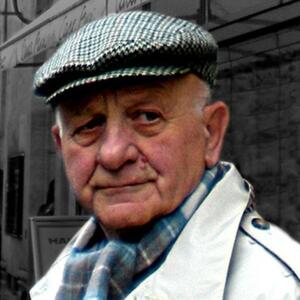
Written by: Slobodan Vuković
When Montenegro got Ulcinj in 1880, journalist and poet Simo Popović, was appointed as the regional manager of Bar and Ulcinj. Previously, in 1871, Prince Nicholas he invited Simo Popović to Montenegro and entrusted him with editing the first Montenegrin newspaper, "Crnogorac"; that's how Montenegrin journalism started. After the publication of "Crnogorca" stopped, Simo Popović edited "Glas Crnogorca", which began to be published in 1873. Popović, as journalism theorists emphasize, was also the editor of the weekly "Crnogorka", the first Montenegrin literary magazine, which, under the motto "A contribution to Montenegrins for entertainment, literature and science", was published from July 10, 1871. Of course, Prince Nikola gave his consent for the launch of all these newspapers. He also collaborated in "Crnogorka".
Prince/King Nikola, a student of Paris, knew well what journalism was, so he brought an excellent intellectual Popović who worked in Montenegro for forty years, and from 1895 to 1903 he was the Montenegrin Minister of Education and Church Affairs, Prince Nikola's secretary . He died in Ulcinj in 1921.
Simo Popović is the founder of Montenegrin journalism.
He was born in Srijem, on August 19, 1846. He studied high school in Vinkovci and Sremski Karlovci; He attended high school in Belgrade. At the beginning of 1866, he became a member of the editorial board of the newspaper "Zastava" in Novi Sad. Leftist-oriented, Simo Popović harshly criticized the regent's regime in Serbia. After the murder Prince Mihailo In 1868, the Belgrade police forbade him to come to Belgrade...
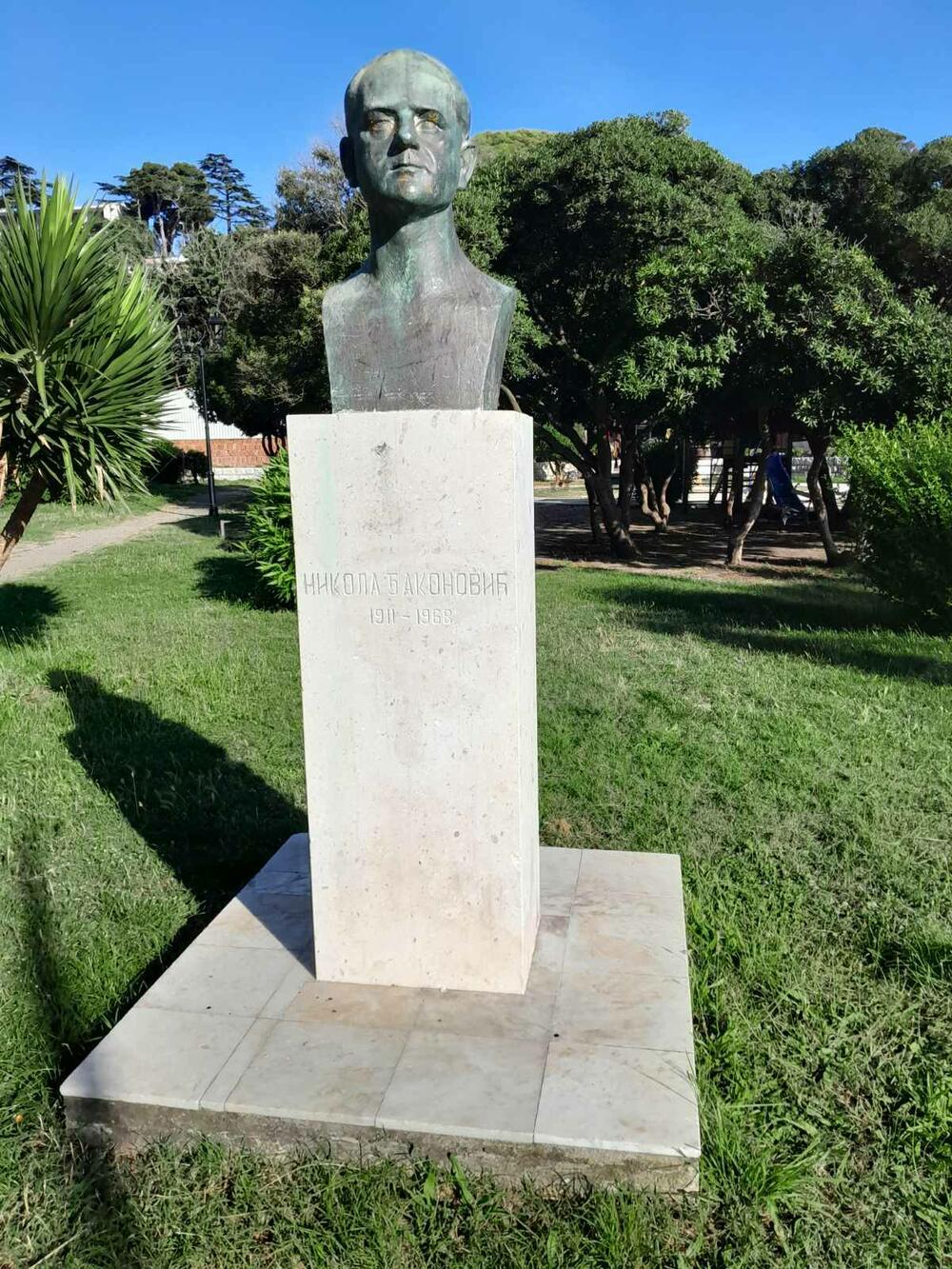
...The sea is hazy on Ulcinj's City Beach, full of bathers; children's voices ring out happily. Next to the Pristan promenade, a small park with several white marble sculptures; children's playground and bust Nikola Đakonović, (1911-1968), born in Ulcinj, prominent Montenegrin revolutionary. Đakonović graduated from the Faculty of Law before World War II. In 1940, he lived in Podgorica, in Vučedolska Street, number five. On August 1940, XNUMX, an elegantly dressed man, an engineer, came to Đakonović Slavko Babić, for a short meeting. It was, in fact, Tito; then s Blazo Jovanovic and his wife Lydia continued to Žabljak, where he will attend the Eighth Provincial Conference of KPJ for Montenegro, Boka, Sandžak, Kosovo and Metohija in Baram Žugić.
Even today, in Vučedolska Street in Podgorica, there is a house where Nikola Đakonović from Ulcinj lived. There is a memorial plaque on it that reminds that Tito stayed there for a short time, under the conspiratorial name Eng. Slavko Babić.
After the end of World War II, Nikola Đakonović was a minister and vice president of the Executive Council (Government) of Montenegro; then the president of the Supreme Court of Montenegro... His daughter, Bojana, was an excellent journalist for Pobjeda.
Traditionally, Ulcinj has excellent journalists; there they are Ibrahim Berjasi, Suzana Mujić, Mustafa Canka... Unforgettable Aleksandar Aco Janinović, scion of a virtuous family from Ulcinj; a great journalist and a good man; it goes with each other. Janinović's superb reportages about Ulcinj, a city that reflected multi-ethnic, civic Montenegro, are remembered.
Ulcinj is the old town; one of the most important tourist spots on the Montenegrin coast. The sandy beaches of Ulcinj are famous; olive growing and fishing developed. There was also a salt pan, the largest in the former Yugoslavia. And the attention of tourists is particularly attracted by the Old Town of Ulcinj.
...And while the sun was smoldering over the Old Town on a June afternoon, I remembered the academics Dr. Pavle Mijović (1914-1996), art historian, publicist, zealous researcher of Ulcinj's past, first manager of the newly founded Ulcinj Museum, dean of the Faculty of Culture in Cetinje...
From his first historical-artistic book "The Bokokotor Painting School of the XVII-XIX century" which was printed in 1960, to the recently published "Trail of the Ancient Cultures of Montenegro", Pavlo Mijović managed to direct his scientific and related cultural interests towards the soil of Montenegro, too rich with all the remains of civilization.
Now, he told me, he expresses himself a little more publicly, which is a consequence of the path he has taken.
- I think it was my duty to accept the role of the first director of the Ulcinj Museum. In addition, I feel great personal satisfaction that after many years of research in Ulcinj, I will apparently experience what is the ultimate goal of people in my profession, to put scientific and archaeological-artistic discoveries at the service of their people - Pavle Mijović told me back in 1970.
- The large complex of the Old Town of Ulcinj, its at least two and a half thousand-year-old citadel with Illyrian, Greek, Roman, Byzantine, Zeta, Albanian, Venetian and Turkish historical and profane buildings and objects, has been turned into a unique museum, more under the open sky than under the roof. Thanks to the efforts of the conscious and progressive citizens of Ulcinj and the painstaking work of researchers, this cultural debut of Montenegrin's southernmost coastal city, with its permanent museum exhibition, lectures, exhibitions, concerts, etc. it will, I hope, become an unquenchable educational and educational focal point, where the youth, those who are eager for knowledge, all the people of Ulcinj and their many guests, will be permanently warmed up.
Pavle will tell me that in our cultural heritage, a lot of weeds have grown up, no less harmful than what grows as a parasitic plant on fields sown with grain.
- The human strain of that triscot brings to the heritage of our culture its unlived primitivism, a terrible urge to destroy everything that the sower did not have the astonishing "courage" to be in the role of omniscient and sole judge in all matters of cultural creation - says Pavle Mijović.
- It is high time to point out this phenomenon. At the same time, I would like to point out that I am not to blame for the follies committed against culture, as the great Marxist theoretician said. Plekhanov, this or that personality, but their perverted understandings, their "understandings" of history and culture...
Pavle Mijović was born on June 21, 1914 in the Crmnica village of Brijege. He graduated from the Faculty of Philosophy, Department of Art History, in Belgrade. Doctorate in the field of historical sciences. He was a war correspondent for "Borba" and editor of Tanjug; press attaché at the FNRJ Embassy in Moscow, then adviser for press and culture at the FNRJ Embassy in Stockholm.
He told me that he had devoted almost his entire life to the struggle for freedom from oppression of all kinds.
In the days when we had the conversation, Pavle Mijović retired from the Editorial Office for the History of Montenegro. He informed the members of the Editorial Board and the Executive Council of Montenegro, which appointed him to that position, about his resignation.
- The crisis was created already on the same day when the Editorial Board was formed on December 30, 1961. The highest Montenegrin leadership at the time included in the composition of the Editorial Board, which brought together the best historians of Montenegro - and two non-experts, i.e. non-historian. According to one's understanding, it should have been a guarantee that the scientific workers who were entrusted with such a delicate and specific job, such as the preparation of a large multi-volume scientific work on the past of Montenegro, would be "on the line". In the meantime, the state and the party have renounced such a role in science and art, but these and other profound changes in our society have not affected the Editorial Board in the least in the past nine years - says Pavle Mijović.
- Apart from any institution in the country, it was left aside by the law on scientific work and self-management, which includes expertise, election and re-election, and its own self-management mechanism as indispensable obligations. It is no wonder that eight of the fourteen members of the Editorial Board for the History of Montenegro, appointed by the Executive Council, resigned. Nikola Đakonović died in the meantime, but he repeatedly offered to resign as a member of the Editorial Board...
The people of Ulcinj wildly celebrated the entry of their "Otranto" into the First Montenegrin Football League. The Ulcinj sky glowed with fireworks; car horns blared late into the night. Congratulations to "Otranto" for entering the First League for the first time, in the hope that they will not play "just one summer". I was a member of the administration of the Football Club "Budućnost" for ten years; now I will sympathize with "Otrant" as well. Nice name; it is associated with long journeys, which always flow down the Otranto... And I have been a great traveler for a long time.
Crowded by numerous tourists; they bury themselves on Mala plaža (City beach), the famous healing sand of Ulcinj. Many curiously climb up to see the thousand-year-old Citadel, the walls of the Old Town, the Balšić tower... The old mosques also attract attention, especially Pašina, with a hammam, built in 1719, then Nemezdah from 1728, Meraja, built in 1779.
Along the narrow, steep street that leads to Gradska plaža, studded with numerous shops full of souvenirs and props for the beach, columns of cars flow, almost touching you if you walk. But the people of Ulcinj are attentive, witty, and through the car window they are happy to talk with guests, tourists, asking them along the way if they are insured...
- I'm not insured - said the older lady, smiling. - But you will answer that I am young and healthy...
Workers are busily painting the white stripes on pedestrian crossings, long since faded by time.
And on Pristan, in the small bakery "Kallaba's" (Cafe and Bake), after a strenuous walk and long sightseeing of the Old Town, you can drink an excellent cappuccino with a free glass of blueberry juice...
See more:
Download the app and follow the news


FOLLOW US ON

