



Montenegrin sculptor and contemporary artist Ivana Radovanović will present herself to the Belgrade audience with her solo exhibition “O Future Time, Are You Strange to Me?”, which will open on Tuesday, October 20, at 20 p.m. at the Kolarac Foundation Gallery. The exhibition includes works created between 2020 and 2026, through which the artist explores the relationship between time, matter, and change, as well as the boundaries between the transient and the permanent.

The exhibition will be opened by art historian Danijela Purešević, author of the accompanying catalog, and visitors will be able to view it until October 31st.
At the center of the exhibition is the relationship between a monumental obelisk and sugar, materials that symbolically contrast civilization's striving for permanence with the inevitability of decay. Through sculptures, spatial installations, objects, reliefs, and video works, Radovanović presents change not only as loss, but also as a process from which new forms and meanings emerge.
A special place is occupied by the video work “Sugar Obelisk - Orevuar Montenegro”, in which the monumental form of the obelisk, executed as a steel structure filled with sugar cubes, is left to the action of time and external forces. Its gradual decay becomes part of the artwork and a metaphor for transience, but also a kind of contemporary memento mori, a reminder of mortality and disappearance.
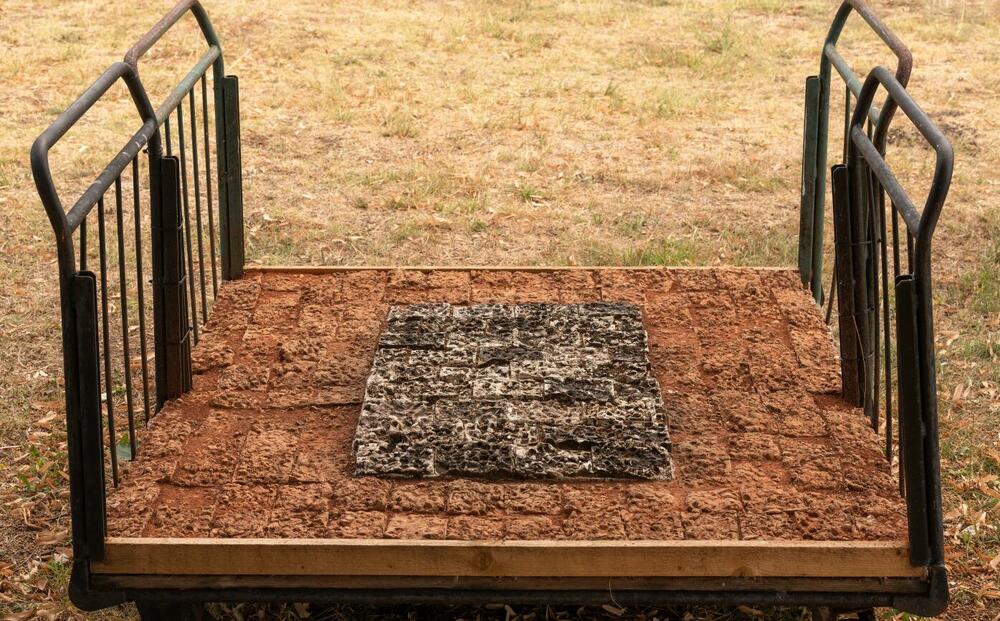
The motif continues in the work “O Future Time, Are You Strange to Me,” in which the moments of the obelisk’s disintegration are preserved in bronze. The contrast between the permanence of metal and the perishability of sugar raises questions about what remains after disappearance, how collective memory is shaped, and whether transience can be translated into a lasting artistic form.
For Radovanović, the obelisk is also a symbol of civilizational victories, power and their contradictions. In the text about her presentation at the exhibition “Sculpture 23”, the artist explained that the work “Sugar Obelisk - Orevuar Montenegro” deals with the human need to discover the truth and question reality, but also with the possibility that change does not necessarily mean progress.
Radovanović finds inspiration for the title of the exhibition and part of his artistic research in the poetry of the Montenegrin poet Ratko Vujošević, especially in his poem "Orevuar Montenegro" from 1965.
Time as a material
In Radovanović's work, a sculpture is not necessarily a finished and unchanging object. Earth, clay, straw, wool, jute, metal, glass, bronze and sugar become materials whose meaning changes in contact with space and time. The process of creation, but also of decomposition, is an integral part of artistic expression.
This approach was also present in her exhibition "Village", presented in 2025 at the Kolektor space in Podgorica, where she explored the relationships between the natural and the artificial, the stable and the fragile, through the decomposition and transformation of materials.
In her text for the Belgrade exhibition, Danijela Purešević points to the importance of time, movement and process in Radovanović's artwork. By translating transient phenomena into sculptural forms, and then reconnecting them with the ephemeral, the artist builds an ambient whole in which the material and the spiritual, destruction and renewal, intertwine.
The starting point of the exhibition is a Latin sentence from Ovid's "Metamorphoses": Omnia mutantur, nihil interit (Everything changes, nothing perishes). This thought connects the works into a whole that views change as a fundamental property of existence, and disappearance not necessarily as a final end, but as a transition to another form.
From Cetinje to the Venice Biennale
Ivana Radovanović was born in 1983 in Podgorica. She graduated in 2006 from the Faculty of Fine Arts, University of Montenegro in Cetinje, where she completed her master's degree in sculpture in 2009. She received her PhD in 2016 from the Faculty of Fine Arts in Belgrade, and works as an assistant professor at the Faculty of Fine Arts in Cetinje.
Among the significant chapters of her international career is representing Montenegro at the 57th Venice Biennale in 2017. As a Fulbright Scholar, she spent time in the United States for postdoctoral research, and in 2019 she was the first artist from the region to be accepted into the Silvermine Fulbright Art Residency program.
During her career, she has participated in numerous international exhibitions, artist residencies and symposiums. Among the awards she has received are the Grand Prix at the 37th Montenegrin Art Salon “13. November” in 2015 and the award at the BJCEM Youth Biennale in Milan the same year, as well as an honorary mention from the International Sculpture Center in the United States in 2023.
The exhibition "O Future Time, Are You Strange to Me" was supported by the Ministry of Culture and Media, through the Public Competition for Co-financing Projects in the Field of Visual Arts for 2026.
See more:
Download the app and follow the news


FOLLOW US ON

