



Glorification of a deceased war criminal Ratko Mladić shows that the so-called dealing with the past officially does not exist in the former Yugoslavia, and that the ideologies that resulted in the atrocities here are still very much alive, even though the armed conflicts have ceased.
With this assessment, the interlocutors of "Vijesti" answer questions about how the celebration of Mladić in Montenegro explains why the process of dealing with the past has not yielded the expected results, and what steps the state had to take to prevent this from happening.
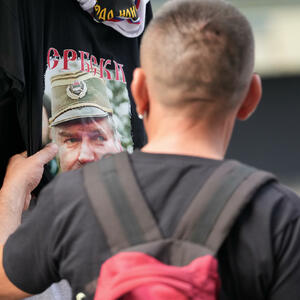
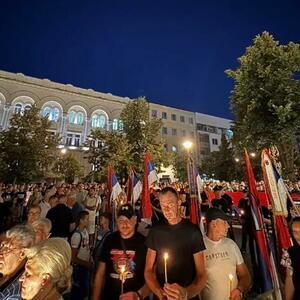
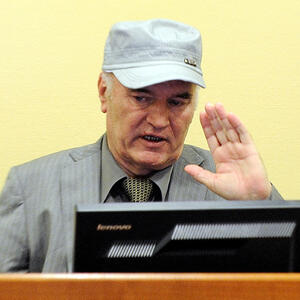
Mladić, the former commander of the Army of Republika Srpska, died on August 27 in The Hague, and within hours he was publicly eulogized in Serbia and Bosnia and Herzegovina (BiH) - especially in Republika Srpska - through gatherings, banners, torches and messages presenting him as a hero.
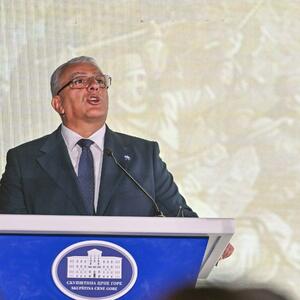
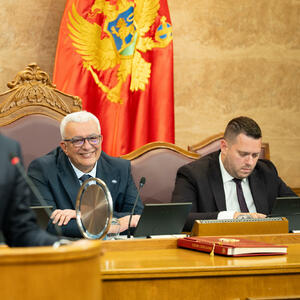
In Montenegro, the most attention was drawn to the reactions of individual state officials and politicians. The President of the Parliament Andrija Mandic (New Serbian Democracy) expressed condolences to the Mladić family, while his party colleague and the first man of Pljevlja Dario Vranes published an obituary calling Mladić “the immortal Serbian general.” Some local officials also expressed their respect for Mladić.
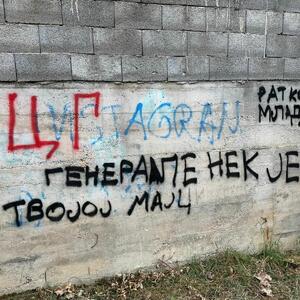
Graffiti glorifying Mladić was removed yesterday from the retaining wall in front of the house of a Bosniak Party (BS) MP Kenane Strujić Harbić in Pljevlja, which had dawned the day before.
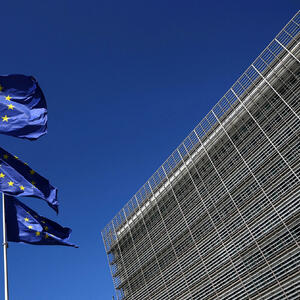
The European Commission reacted to the glorification, stating that the glorification of war criminals has no place in the EU, nor in countries that want to join that community.
In June 2021, Mladić was sentenced to life imprisonment by a final verdict for the genocide in Srebrenica, the persecution of Bosniaks and Croats, the terrorization of the citizens of Sarajevo, and the taking of UNPROFOR members hostage.
Confrontation - neither started nor ended
Director of Human Rights Action (HRA) Tea Gorjanc Prelevic She told "Vijesti" that in Montenegro, dealing with the past does not officially exist as a clearly defined process. She claims that there is neither a strategy nor a public policy on this matter.
She states that the government Zdravka Krivokapića (which existed from December 2020 to April 2022) did not adopt the transitional justice strategy they proposed.
"That's why today we are all wasting time and face discussing whether a serious war criminal, such as Ratko Mladić, can be glorified as a hero by anyone in public office," said Gorjanc Prelević.
She pointed out that, instead of a comprehensive and fact-based policy of dealing with the past, there have been individual and mostly forced ad hoc moves by the authorities that fall within that process. Among them, the HRA director cites the introduction of lessons on the collapse of the SFR Yugoslavia and the Srebrenica genocide in history classes, the adoption of resolutions on Srebrenica in the Parliament and the vote for the UN resolution on the international day of remembrance for the victims of that genocide, the adoption of the status of civilian victims of war, and the provision of one-time compensation to the families of victims.
As important steps, she highlighted the reconciliation with the victims of the war crime of the deportation of Bosnian-Herzegovinian refugees, the final verdict for the crime against the Klapuh family, for the crime in Štrpci, and in the Morinj camp, compensation for the camp inmates, and the apologies that politicians sent to Croatia, i.e. to the families of the victims of the deportation of Bosnian-Herzegovinian refugees.
"However, all of this is insufficient, because it does not provide the full picture of what happened in the 1990s, nor does it explain the causes. And people need to know that," the interviewee notes, adding that there is a great need for citizens to be officially and factually informed about Montenegro's role in the wars of the 1990s, because they have been exposed to propaganda for decades. She recalls a 2020 survey, according to which only about 17 percent of citizens knew the historical facts about that period, while almost 60 percent believed that there was not enough information.
Expert in criminal law and transitional justice from BiH Goran Šimić He assessed that the process of confrontation never began, lasted, or ended, because those who fought in Montenegro and the former Yugoslavia never wanted it.
"The armed conflict, or rather the war, divided all of our societies, mainly along ethnic lines, and when the armed conflict ended, the war did not end. Only the gunfire, shooting and killing ended, and the ideologies that were present, the ideologies represented by Ratko Mladić and some other ideologies - continued to live on," Šimić told "Vijesti".
He claims that the latest developments regarding Mladić actually show that the ideologies that started and led the conflicts and that promoted certain values in our societies are very much alive and were not defeated the moment the armed conflicts ended.
"On the contrary, they were only inhibited at that moment because the favorable conditions for their existence had disappeared. Now that those favorable conditions are reappearing, it becomes clear that these ideologies are indeed living in our societies and that they are actually just waiting for a favorable moment to 'come out of the shadows' again and appear in full light in our societies," Šimić emphasizes.

Professor of International History at Utrecht University and Research Fellow at the Department of War Studies at King's College London Iva Vukušić She told "Vijesti" that dealing with the past, deeply and truly, is unfortunately difficult and rarely achieved.
He explains that most societies, like most individuals, are reluctant to admit their own mistakes, misconceptions, and lies, preferring to remain faithful to whatever version of the past flatters them and makes them feel good.
"I live in the Netherlands and it's similar here when we talk about colonial violence. It's difficult to talk about it, excuses are found, false or manipulative information is presented," says Vukušić.
She pointed out that, in terms of coping, the former Yugoslavia was stuck, after things seemed to be getting better at the beginning of the new, 21st century.
"Nationalist political parties and nationalist narratives and myths in which only we are right and the other side is evil and criminal - unfortunately, they prevail," she believes.
The interviewee pointed out that politicians manipulate "naive people in order to remain in power" and "ignite the masses" while failing to truly engage in the fight against corruption and the quality of life.
"Instead of dealing with real problems, they are milking that cow of nationalism to exhaustion," adds Vukušić, assessing that dealing with the past is a process that has now slowed down, quieted down, and may even stop.
"War crimes trials are becoming less frequent, there are fewer defendants and witnesses, as well as survivors, and the external pressure that forced countries in the region to deal with them at all has ceased," she noted.
DON'T MISS IT




Praise doesn't mean everything is lost.
Gorjanc Prelević assessed that the main problem is that the authorities in Montenegro have not yet sufficiently emancipated themselves from the influence of the Belgrade authorities, namely the Serbian Orthodox Church (SPC), whose position on the wars of the 1990s and the crimes committed in them is extremely biased.
"The latest manifestation of this is the announcement that war criminal Ratko Mladić, convicted of genocide and other crimes against tens of thousands of people, will be buried in Serbia, with the highest state honors," she said.
He notes that the population of Montenegro is exposed to echoes of this "amoral attitude" - in the form of a telegram of condolence sent by the president of its parliament to Mladić's family, or statements by individual deputies or mayors in which Mladić is presented as a hero of the Serbian people.
"These are very dangerous misuses of the term 'people', but there is no decisive reaction from the top authorities to all this. On the contrary, people who admire Mladić are welcome in the Government and are at the head of the Parliament and certain municipalities. All of this, unfortunately, portrays Montenegro as a country unprepared to adopt European values," she pointed out.

.
Goran Šimić reiterates that the process of shedding light on events from the past has never seriously begun.
"In essence, after the end of the armed conflicts, we may have expected that these hostilities, which were the fuel of all these conflicts and suffering, would disappear by themselves in our societies. Of course, this did not happen. And it did not happen in any conflict or post-conflict society, but it was necessary for society, the state and its organized representatives to seriously address these issues and remove these ideologies from society as much as possible, as happened in Germany and Western European countries to a large extent," he states.
He believes that this does not mean that these ideologies do not exist in these societies, but adds that "official societies" have taken positions that are the opposite of this. He pointed out that in other societies, repressive measures have been introduced against those who promote such ideas, while the official position is that such values are not promoted, which, he said, is not the case in Montenegro and other countries of the former Yugoslavia.
"In fact, we are very willing to flirt not only with the last war, but with all our past wars, where many social, political so-called elites will use these conflicts to strengthen their social position on the social scale. So it would be more honest to say that we have never actually systematically entered that story, and neither has Montenegro," Šimić concluded.
Iva Vukušić claims that there are no clear criteria for measuring the success or failure of the process of dealing with the past, but that it has never been approached seriously enough, and that glorifying a war criminal does not mean "that everything has failed, nor that there is no hope for progress."
She emphasized that the fact that individuals still celebrate today Hitler - does not mean that the process of dealing with the past in Germany and Europe has failed, but that the process in the former Yugoslavia could certainly have been more successful.
"There are many reasons for disappointment and frustration, such as, for example, the promise that Mladić will be buried with state honors. This is really crazy for a country that, at least declaratively, wants to belong to a pluralistic society of normal countries. Normal countries don't do that...", said Vukušić.
She says that not everything is black, reminding that in many countries, processes of confrontation have been absent, while in the former Yugoslavia there have been more trials, the remains of a large number of victims have been found, and numerous facts about the wars have been established.
"Today, only total marginals say that the siege of Sarajevo never happened, that Vukovar was not razed to the ground, that Srebrenica did not exist... This is because the public was nevertheless exposed to the evidence presented in The Hague, and there is thousands of pieces of evidence available, and that archive is, at least for now, accessible, until it is eventually closed due to the UN funding crisis - which is absolutely unacceptable," said Vukušić.
She said that the problem lies with local politics and politicians, intellectuals, religious leaders and mayors, but that the greatest responsibility lies with those at the state level, for whom this topic is not a political opportunity - they are afraid of it or it is simply not important to them.
"Dealing with the past is not something that can be truly achieved from anywhere other than from within," the interviewee points out.
Without the desire to end evil ideologies
Responding to the question of what specific steps the state had to take to prevent what happened to Mladić in recent days, Gorjanc Prelević emphasized that Montenegro, in order to ensure peace, respect for human rights and the rule of law, must turn to a truthful portrayal of the past in education, in public memory.
"By erecting monuments for the victims, declaring days of remembrance and commemoration of the crimes, and by opening state archives for the study of that period and the prosecution of those who committed crimes in the name of the state during that period," she stated.
Goran Šimić said that the countries of the region, including Montenegro, have failed to take a systemic approach to confronting the issue.
"What states should have done is to conduct trials, accept final judgments and implement them in the social space. That has never happened here," he reminds.
He pointed out that Montenegro, like societies in the region, should have promoted the truth about war events, but that the problem was that it was never seriously established, but rather that states interpreted the past in accordance with political interests and changes in government.
"There is essentially no such systemic approach, but rather it is ad hoc and aimed at downplaying the role of official bodies of a state in crimes, while always pointing the finger at others, which ultimately leads to what we have now - that the ideologies of crime are alive," Šimić assessed.
What makes this story more problematic, according to him, is that when these ideologies, as is the case in Montenegro and, to a large extent, in Bosnia and Herzegovina, come to the position of social authority - they gain the resources to come out of the shadows and actively use budget funds to promote these ideologies.
He notes that confrontation was not absent due to a lack of time, opportunity, or established facts, but because societies simply did not want it and did not want it.
"We did not want to put an end to the evil ideologies that ruled in this region in the 1990s. On the contrary, we wanted them to remain very much alive and present in our lives, because, after all, these are obviously ideologies that are very respected in this region," concluded Šimić.
Vukušić: We only mention criminals if they are on the enemy side
Iva Vukušić assessed that the countries of the region must do their best to ensure that the archives of the Hague Tribunal remain accessible to everyone on the internet, invest more in trials and research into the past, and sincerely cooperate in this regard.
"Survivors are talked about 'on their side', but they are essentially just being used for political points. We only mention perpetrators if they are on the enemy side - we generally don't touch 'ours'," she points out. She states that education must be based on facts, especially unpleasant ones, and that, especially at higher levels of education, it must deal with critical thinking, not empty national myths.
"Monuments, scientific research, public commemoration of the suffering, public apologies, reparations... We must fight against disgusting, offensive graffiti and not give room to liars to fool us and manipulate us... All of this is important for the situation to normalize and for us to build the future on slightly healthier foundations. There can be many steps, if there is the will," Vukušić concluded.
See more:
Download the app and follow the news


FOLLOW US ON

