



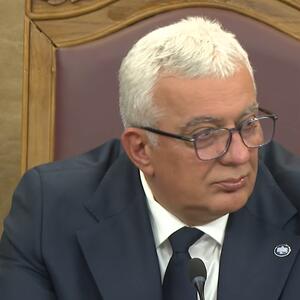
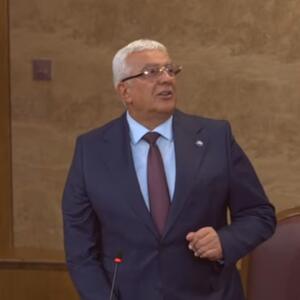
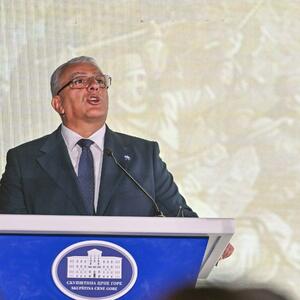
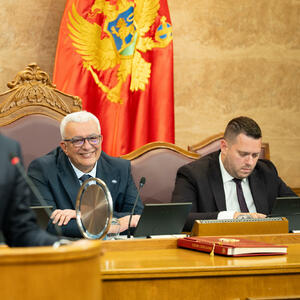
The views advocated by the head of parliament, Andrija Mandić (New Serbian Democracy), deepen social divisions, while his actions simultaneously damaged the reputation of the Parliament and the international credibility of Montenegro, states the initiative for his removal.
The Democratic Party of Socialists (DPS) parliamentary group will send it to other parliamentary groups in the Parliament today.
The DPS announced its initiative to remove Mandić last Monday. Their leader, Danijel Živković, said at the time that Mandić had "crossed the line beyond which one cannot close one's eyes" by expressing condolences over Mladić's death.
DON'T MISS IT
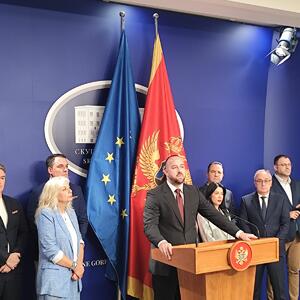

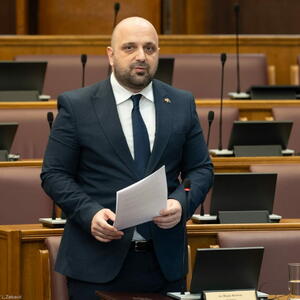

Support has so far been announced by the Bosniak Party (BS), the Civic Movement (GP) URA, the European Union, the Croatian Civic Initiative, independent MP Nikola Janović, and MP from the Europe Now Movement (PES) club Seid Hadžić.
On the other hand, PES, Democrats, Democratic People's Party (DNP), United Montenegro and Socialist People's Party (SNP) have announced that they will not vote for Mandić's dismissal.
We are publishing the text of the initiative in its entirety:
"The function of the President of the Parliament of Montenegro implies a special political and institutional responsibility, as well as the obligation to preserve the reputation and integrity of the House of Representatives of all citizens. However, during his mandate, Andrija Mandić continuously used the authority of that function to promote views that deepen social divisions, while his actions simultaneously damaged the reputation of the Parliament and the international credibility of Montenegro. Such actions are sufficient reason to reopen the issue of his political responsibility and trust for the continued performance of the function of the President of the Parliament before the MPs.
The immediate reason for submitting this proposal is Andrija Mandić's decision to publicly express condolences on the death of Ratko Mladić, who was finally sentenced to life imprisonment for genocide in Srebrenica, crimes against humanity and other war crimes committed during the war in Bosnia and Herzegovina.
The notification that the condolences are sent on behalf of both the party and the individual cannot be separated from the fact that Andrija Mandić holds the office of President of the Parliament of Montenegro. The President of the Parliament is not just a representative of a political party, but a holder of a position that entails special institutional responsibility, protection of the reputation of the Parliament and respect for the values on which the constitutional order of Montenegro and its commitment to be the first member of the European Union are based.
Showing respect for a finally convicted war criminal, especially a person convicted of genocide in Srebrenica, is incompatible with the responsibility of the position of speaker of the parliament of a state that is obliged to respect the judgments of international courts, foster a culture of remembrance, and contribute to reconciliation and good neighborly relations.
The seriousness of such a procedure and its consequences for Montenegro's international credibility are also confirmed by the reactions of our European partners.
The European Commission, reacting to the messages of Montenegrin politicians regarding the death of Ratko Mladić, has unequivocally stated that any glorification of war criminals is contrary to the most fundamental European values and that such actions have no place in the European Union or in candidate countries. At the same time, the European Commission recalled that Ratko Mladić was serving a life sentence for crimes against humanity and genocide in Srebrenica, clearly labeling him as a war criminal.
Of particular importance was the official reaction of the Republic of Croatia, a member state of the European Union with which Montenegro shares a border and whose consent will be necessary in the final stages of the European integration process. The Croatian Ministry of Foreign and European Affairs assessed the expression of condolences by the President of the Parliament of Montenegro on the death of Ratko Mladić as unacceptable and contrary to the values on which the European Union is based. At the same time, it was stated that Croatia would insist in the accession negotiations on facing the past, prosecuting war crimes, respecting the judgments of international courts and good neighborly relations, with a warning that such messages do not contribute to Montenegro's European path.
When the actions of the President of the Parliament of a candidate country produce such reactions from the institutions of the European Union and neighboring member states, then it can no longer be presented as a matter of his personal or party beliefs. It becomes a matter of political responsibility for the reputation of the institution he represents and for the consequences that his actions have on the national interests of Montenegro.
This event, however, is not an isolated incident, but a continuation of the manner in which the office is performed, which has led to the issue of the political responsibility of the Speaker of the Parliament being raised twice already in this convocation.
Andrija Mandić's mandate was marked by long-standing problems in organizing the work of the parliament and exercising its control function, a selective attitude towards national holidays and symbols of Montenegro, as well as the use of the position of the President of the Parliament to promote political and ideological positions that do not express the values and interests of all citizens represented by the Parliament.
The irresponsible attitude towards parliamentary procedure was particularly evident in the adoption of important legal solutions without a real parliamentary debate, including the Law on Weapons and Ammunition, which, despite the previous announcement by the President of the Parliament that it would not be debated that day, was returned to the agenda just before midnight on July 31 and adopted before the end of the regular session. Such a practice reduces parliamentary debate to a mere formality, renders the democratic procedure meaningless and denies citizens the right to have a real influence on the adoption of laws that directly regulate their rights and obligations through their elected representatives.
The attitude of the President of the Parliament towards national holidays and national symbols of Montenegro is particularly worrying. The absence of a congratulatory message on the occasion of May 21st - Independence Day, one of the most important national holidays, as well as the way in which certain events were organized under the auspices of the Parliament, including the commemoration of the Battle of Fundina using symbols that are neither official state nor credibly established historical symbols, further confirm the practice in which the authority of the Parliament is abused to affirm one's own ideological and identity interpretations.
The Speaker of the Parliament has the right to political and ideological beliefs, just like any other citizen and MP. However, performing the function of Speaker of the House of Representatives of all citizens implies a higher degree of responsibility, institutional restraint and awareness that his actions affect the reputation of the Parliament, relations within Montenegro and the international position of the country.
Montenegro is in a crucial phase of its accession to the European Union. European integration is not just a matter of meeting technical criteria and adopting regulations, but also of belonging to a system of values that includes an unequivocal attitude towards war crimes, respect for the decisions of international courts, fostering good neighborly relations and responsibly dealing with the past.
Therefore, we believe that the last action of the President of the Parliament crossed a line beyond which the issue of his responsibility can no longer be relativized by the need to preserve the parliamentary majority or political stability.
We are convinced that the manner in which Andrija Mandić has continuously performed his function, and especially his latest action regarding the death of Ratko Mladić, is not compatible with the political and institutional responsibility of the president of the legislative house of a country that is about to become the first member of the European Union.
"Given all of the above, we believe that Andrija Mandić does not possess the political and institutional credibility necessary to perform one of the most responsible state functions, which is why we call on the members of the Parliament of Montenegro to support the proposal for his dismissal," the text states.
See more:
Download the app and follow the news


FOLLOW US ON

