



That the Criminal Code explicitly states that glorifying war criminals is like Ratko Mladić or Pavle Đurišić criminally, prosecutors would have no choice, as they do now, but to prosecute anyone who glorifies those convicted of the most horrific crimes, and the courts would punish them adequately.
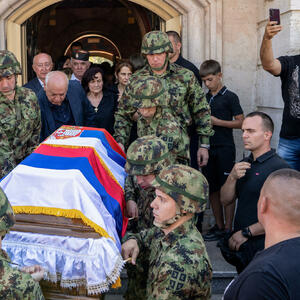
Mladic's recent death has sparked a wave of praise for the former commander of the Republika Srpska Army, who was found guilty by the Hague tribunal of genocide in Srebrenica, crimes against humanity and violations of the laws and customs of war in Bosnia and Herzegovina (BiH).
He was also celebrated by Montenegrin politicians, as well as a part of the local clergy of the Serbian Orthodox Church, while the head of parliament Andrija Mandic announced that he had sent a telegram of condolences on the occasion of Mladić's death, which is why a decision will be made on September 24th about his removal from office.
DON'T MISS IT

However, it is questionable whether he and those who openly glorified Mladić would have engaged in such moves if the regulations clearly defined that glorifying war criminals results in criminal liability.
The Criminal Code (CC) of Montenegro stipulates (Article 370, paragraph 2) that anyone who publicly approves, denies the existence of, or significantly minimizes the gravity of genocide, crimes against humanity, and war crimes, in a manner that may lead to violence or incite hatred, and if these criminal acts have been established by a final judgment of a court in Montenegro or an international criminal court, shall be punished by imprisonment for a term of six months to five years.
However, this formulation does not explicitly state that glorifying war criminals, and not just crimes, is punishable, which is why such cases often end with criminal charges being dismissed.
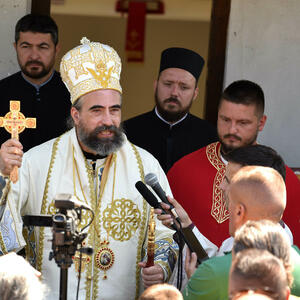
The latest example of this is the decision of the Bijelo Polje Higher State Prosecutor's Office to dismiss the charges against the Metropolitan of Budimlje-Niksic. The method, assessing that there is nothing controversial in last year's speeches in which he praised the notorious Chetnik commander Đurišić.
Therefore, the question arises whether Montenegro should follow the example of Bosnia and Herzegovina (BiH), which in its Criminal Code (Article 145a, paragraph 6) prescribes the following:
“Whoever grants recognition, award, monument, reminder or any privilege or similar to a person convicted by a final judgment for genocide, a crime against humanity or a war crime, or names a public facility such as a street, square, park, bridge, institution, establishment, municipality or city, settlement and populated area, or similar, or registers a name after or in the name of a person convicted by a final judgment for genocide, a crime against humanity or a war crime, or in any way glorifies a person convicted by a final judgment for genocide, a crime against humanity or a war crime, shall be punished by imprisonment for at least three years.”
Murić and Suljević: Amend the Criminal Code
Attorney Velija Murić He told "Vijesti" that when deciding on possible criminal liability, one is faced with a dilemma as to what is actually at stake, because the Criminal Code does not clearly stipulate that glorifying war criminals is punishable. He stated that prosecutors are skeptical, or find excuses to dismiss criminal charges, because it is not precisely defined that possible incitement of national, religious and racial hatred also applies to glorifying war criminals.
"I believe that the Ministry of Justice should propose amendments to the Criminal Code in that section and define a clear legal provision as a disposition of the legal norm that would be adapted for implementation," he explained.
The Ministry announced a response to "Vijesti" on this topic for today.
Murić also noted that regardless of that proposal, he believes that according to existing regulations, prosecutors have room to initiate criminal prosecution when it comes to glorifying war criminals.
"In parallel with the glorification of the names and misdeeds of war criminals, there is also the legal element of inciting hatred, because glorifying war criminals does nothing but attack those national groups that are victims of the crimes committed," the interlocutor emphasized.

Lawyer Damir Suljević He told the newspaper that he was not convinced that anyone could be successfully prosecuted for glorifying war criminals under the existing provisions of the Criminal Code.
"The problem is that glorifying war criminals, in itself, can hardly be qualified as a criminal act of inciting national, racial or religious hatred, unless something else is said on that occasion that represents a direct call for violence or hatred towards a certain group. This, among other things, stems from previous practice, including the latest decision of the Higher Prosecutor's Office to dismiss criminal charges against Metodije," he assessed.
Suljević told "Vijesti" that, although glorifying war criminals is perhaps closest to the essence of the aforementioned criminal offense, inciting hatred assumes that something is publicly stated in a way that can lead to violence or hatred towards a certain group, while glorifying a war criminal, as a rule, boils down to publicly presenting that person as a hero or role model, without the need to directly invoke violence or hatred towards anyone.

He stated that, while he is not an advocate of filling the Criminal Code with “every socially unacceptable behavior,” he believes that, given the scale of the problem and the lack of other mechanisms, and in order to preserve the values of society, the possibility of making such behavior the subject of a separate criminal offense should be considered.
DPS: Open a discussion
Sonja Popovic, MP and spokesperson for the strongest opposition party, the Democratic Party of Socialists (DPS), told "Vijesti" that it is unacceptable that in a country that aspires to be the first member of the European Union, it has become almost a practice to glorify convicted war criminals and affirm "dark ideologies of the past" from important social and public positions.
She said that it is true, and also devastating, that glorification of war criminals often goes without adequate sanction, and that she therefore considers it completely justified to open a debate on amendments to the Criminal Code, including the possibility of introducing a special criminal offense that would clearly and precisely sanction the glorification of finally convicted war criminals, especially when such conduct constitutes incitement to hatred, intolerance or justification of crimes.
"Such a norm, of course, would have to be defined precisely enough to make a clear distinction between freedom of expression, scientific and historical debate, on the one hand, and public glorification of crimes and their perpetrators, on the other. Freedom of speech is one of the fundamental values of a democratic society, but it must not serve as a cover for the normalization of war crimes, hatred and ideologies that have left behind enormous victims," she explained.

Popović said that it is important to improve the legislative framework and ensure consistent implementation, but that repressive policies alone are not enough, but that it is equally important to educate the coming generations and build a culture of remembrance based on facts, final court rulings and respect for victims.
"Because a society that relativizes crimes and makes heroes out of their perpetrators does not discuss the past - it creates the danger of passing on the patterns of that past to future generations," the interviewee stated.
Vasić: There were verdicts, but they do not contribute to reconciliation
Lawyer from Bosnia and Herzegovina Tatjana Vasic She told the editorial staff that several verdicts have been issued in that country for the criminal act of denying war crimes and glorifying war criminals, adding that the need to criminalize such an act at all indicates that the International Criminal Tribunal for the former Yugoslavia, and subsequently the war crimes trials in BiH, have not achieved their basic purpose.
"... And that is to determine the act of crime, those responsible for the crime, and for each side to condemn the crime, and for the families of the victims to receive some satisfaction. Instead, in BiH, all sides systematically glorify their own victims and belittle the victims of other parties, and the act of crime itself is either denied, minimized, or justified," she told "Vijesti".
Vasić emphasized that she believes that trials for glorifying war crimes and their perpetrators will not contribute to the basic purpose, which is reconciliation between peoples and a shared future life, especially while politicians are more concerned with the war past than with the future of the peoples in this region.
Many countries across Europe have provisions similar to those in the Montenegrin Criminal Code.
Although BiH is the only one that has explicitly banned the glorification of war criminals, Spain, through its Law on Democratic Memory, which is a misdemeanor, not a criminal offense, has prescribed fines of up to 150.000 euros for publicly glorifying the dictatorship of Francisco Franco, its leaders and symbols.
Case filed against Metodije
The Podgorica Higher State Prosecutor's Office has filed a case against Metropolitan Metodije of Budimlje-Niksic for glorifying Mladić, the institution told "Vijesti" yesterday.
"We inform you that a check through official records at the Higher State Prosecutor's Office in Podgorica has determined that a case has been opened against Metropolitan Metodije of Budimlje-Niksic for the criminal offense of inciting national, racial and religious hatred," the response to the editorial board reads.
On August 28, Methodius said at the Piva Monastery that the people in Mladić "recognized all those wonderful and holy qualities of Serbian warriors and knights."
DON'T MISS IT
See more:
Download the app and follow the news


FOLLOW US ON

