



If the initiative of the Democratic Party of Socialists (DPS) to remove the speaker of parliament Andrije Mandić If successful, it would cause a major shake-up within the parliamentary majority, destabilize the government, and deal a serious blow to Mandić's New Serbian Democracy (NSD). If there is not enough support to topple Mandić, he will emerge significantly stronger, with yet another indication that a stable majority cannot be maintained without him.
With these words, the interlocutors of "Vijesti" analyze two possible scenarios for the vote on Mandić's dismissal, which will be decided on September 24th, and their potential consequences for the Montenegrin political scene.
DON'T MISS IT
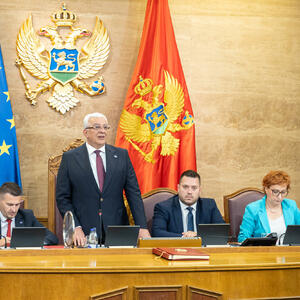
At least 38 MPs, according to publicly announced positions so far, should vote for Mandić's dismissal.
This does not require an absolute majority (at least 41 votes out of a total of 81), but a majority of the deputies present at a session attended by more than half of the total number of them. However, this does not mean that the 38 announced votes guarantee the “fall” of Mandić - because the number of “hands” required for dismissal will depend on how many members of parliament are in the plenary hall - but it significantly increases the chances of it. For now, three votes are needed for an absolute majority, which would guarantee the dismissal of Mandić.
Proposal for his dismissal, due to the condolences he sent on the death of a war crimes convict Ratko Mladić, was initiated by the DPS, and was signed by 35 MPs - 16 from that party, six from the Bosniak Party (BS), four from the Civic Movement (GP) URA, three from the European Union (EU), a MP from the Democratic Union of Albanians (DUA) Mehmed Zenka, MP of the Croatian Civic Initiative (HGI) Adrian Vuksanovic, independent MPs Miodrag Laković i Nikola Janović, including Artan Chobi from the Albanian forum and Ilir Chapuni from the Albanian Alliance.
An independent MP confirmed to the editorial office the day before yesterday that she will support the DPS initiative. Jevrosima Pejović, and support for the initiative was also announced by an MP from the Europe Now Movement (PES) list. Seid Hadzic, and the Albanian Forum for its second representative Nikola Camaj (Vice President of the Assembly).
The ruling PES, Democrats and Socialist People's Party (SNP), and the opposition Democratic People's Party (DNP) and United Montenegro announced that they would not vote to dismiss the speaker of parliament.
Mandić has so far "survived" initiatives for removal twice - in March 2024 and early June 2025.
Djukanovic: Bigger problem for the government
Docent at the University of Donja Gorica Nikoleta Djukanovic She told "Vijesti" that Mandić's dismissal would cause a very strong political upheaval within the ruling majority, but that she did not think it would automatically mean the fall of the government, explaining that the dismissal would primarily open the issue of a new distribution of power relations among the partners and show that the current majority is no longer capable of cushioning all internal conflicts without serious consequences.
"For the NSD, this would certainly be a serious political blow, because the position of the Speaker of the Parliament is not only institutionally important, but also has strong symbolic weight. It is from this position that Mandić has been building an image in recent years of a politician who has gone from a former opposition leader to one of the key pillars of the government and an important partner of the international community. His dismissal would seriously damage that image," she assessed.

Đukanović points out that the other side should not be ignored either - that Mandić and the NSD would very likely try to turn such a development into political capital, presenting the dismissal as an attack on their electorate and their political views.
According to her, the dismissal would not necessarily weaken the NSD in terms of voters, and could even further homogenize their traditional electorate.
"A much bigger problem would be for the government itself. If some of the partners who make up the majority participate in the removal of the parliament speaker, then it becomes very difficult to maintain the thesis of a politically functional and coherent majority. The government might continue to exist formally, but it would be politically much more unstable and dependent on each subsequent vote," the interviewee underlined.
Tadić Mijović: Mandić will only get stronger
Director of the Center for Investigative Journalism of Montenegro Milka Tadic Mijović She told the list that she believes it will be difficult to remove Mandić, as it is unlikely that there will be an absolute majority (41 MPs).
"Even if he is not replaced, I think he will only become stronger. He, by the way, we have all seen in the last few years, is actually only growing on the political scene and is probably one of the strongest political factors. So I do not believe that this (the removal of Mandić) will be the outcome of this initiative," she commented.

When asked what she thought the relations within the government would be like, given that part of the majority (minority party) had announced that they would vote for his removal, the interviewee replied that she did not believe that such a move would disrupt relations among the coalition partners in government at all. She recalled that there were often different tones within the government, on different issues, but that the government held them all together.
"They are not held together by any idea or ideology, just pure pragmatism. I don't believe that will change at all," she told "Vijesti".
When asked where the DPS's position would be if their attempt to remove Mandić fails for the third time, Tadić Mijović responded that the opposition's initiative was a legitimate reaction to Mandić's telegram of condolences to Mladić's family.
"A telegram that would be considered the biggest mistake of anyone who advocates for Montenegro's path to the European Union, because we know that this is a war criminal who was sentenced in The Hague. And it is a completely legitimate initiative. I do not believe that it will weaken the opposition. Because this is more about mathematics than anything else. They simply do not have the majority for this initiative," she underlined.
Perception of power matters
Nikoleta Đukanović assessed that if the head of parliament "survives" the third attempt at removal, he will undoubtedly emerge politically strengthened in a very concrete sense, that is, he will show that his position within the parliamentary majority remains extremely strong even when a very serious and value-sensitive issue arises around him.
She stated that this does not necessarily mean that he will be "stronger than ever", but he will have the additional argument that without him or against him it is not easy to organize a stable majority.
"In politics, the perception of power is very important, and three unsuccessful attempts at removal would certainly further reinforce the impression that Mandić is one of the central actors in the current political system," she concluded.
Đukanović also says that relations within the government would become even more complex, and that the fact that some of the ruling parties would vote for Mandić's removal, and then continue to share power with him, would raise the question of how much of their differences are truly political, and how much they serve to preserve different voter bases.
"Such a majority can survive, but it increasingly resembles a set of parallel political projects that occasionally collide, but remain together primarily because their common interest is participation in government," the interviewee claims.
As for the opposition, Đukanović said that for them, a third failed attempt would be a serious signal that the strategy of personalizing the political conflict through the dismissal of Mandić is not yielding results. According to her, if everything boils down to an attempt to overthrow one man, and parliamentary arithmetic is against it in advance, the opposition risks further increasing Mandić's political importance with these failed initiatives.
Therefore, she adds, it would be more important for the opposition to use this process to more clearly profile political and value differences, and less to create expectations that every new initiative will necessarily lead to dismissal.
"Otherwise, Mandić can come away with additional symbolic capital every time he 'survives'," she emphasized.
Đukanović points out that, essentially, both scenarios pose a problem for the ruling majority.
"If Mandić is removed, a crisis in relations between the partners will open up. If he is not, it will become even clearer how willing individual parties are to overcome deep political and value differences in order to maintain the existing government structure," she said.
Mandić: There is no majority
Andrija Mandić said that there is no necessary majority for his removal, the Parliament announced yesterday.
The head of parliament said that he registered the current initiative, and that it was particularly accompanied by "an extremely cruel and deeply untrue political campaign full of lies and subterfuge."
DON'T MISS IT
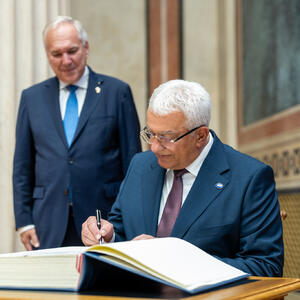
Yesterday in Vienna, during his official visit to Austria, Mandić met with the President of the National Council of that country, Walter Rosenkrantz.
He also said that the initiative for his removal is an integral part of democracy.
See more:
Download the app and follow the news


FOLLOW US ON

