



Montenegro has achieved a lot in the negotiation process with the European Union (EU) and, if it continues to deliver results, it can complete the technical part of the negotiations with the Union by the end of this year or early next year, said Enlargement Commissioner Marta Kos.
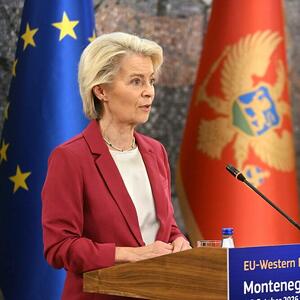
At a press conference presenting a European Commission (EC) document on preparations for a wider Union, she said that enlargement is an investment in a better future for Europe and emphasized that new members will have the same rights as existing ones.
Kos said that the EC supports the Montenegrin government's goal of the country becoming the 28th member of the EU by 2028.
"Montenegro has invested a lot of energy and achieved many good results. Based on that, Montenegro could complete the technical part of the negotiations by the end of this year or early next year," Kos said.
She reminded that the working group is already preparing the accession treaty.
"If everything goes well and according to plan, and when it comes to the positions of the member states, it is possible that Montenegro will sign the accession treaty next year," said Kos.
After that, she added, the date of full membership will depend on how long the ratification process takes.
"Experience suggests that it will take one to two years. The EC supports Montenegro becoming the 28th member of the EU in 2028, if it continues to deliver results, as it has done so far," said Kos.
DON'T MISS IT

She said that roadmaps for the four most advanced candidate countries - Montenegro, Albania, Moldova and Ukraine - would be presented at the end of the month, along with progress reports.
According to her, the roadmaps will contain indicative deadlines and clear results that candidates need to achieve, but each country's path will still depend on its individual achievements.
Kos emphasized that Montenegro is at the very end of the negotiation process.
"Montenegro is at the end. Other countries have not yet opened all clusters. This is a clear sign that the paths we will present at the end of October will be different for those four countries," said Kos. Marta Kos.
She announced that the EC today adopted a communication on preparing for a wider Union, with an analysis of the impact of future enlargement on the EU and an assessment of the adjustments that will be needed so that the Union can function with a larger number of members.
"Enlargement is in our interest. It is about protecting our interests and defending our values. A larger EU is a long-term investment in the peace, security and prosperity of Europe," Kos said.
According to her, an enlarged Union would increase Europe's political and economic influence in a world of increasingly intense geopolitical competition.
Kos said the Commission is proposing five groups of measures to prepare the EU for future enlargement.
As she explained, the first relates to governance, the rule of law and decision-making, including the possibility of wider use of qualified majority voting where EU treaties already allow it.
According to Kos, the EC believes that this could reduce the number of areas in which one country can block a decision supported by all other member states, including certain stages of the accession process.
Kos stated that the second point refers to a stronger framework for the gradual integration of candidate countries before membership.
Kos explained that gradual integration is not a substitute for full membership, but a "bridge to membership".
Gradual integration, according to Kos, would mean that candidates who make progress in reforms and are strategically aligned with the EU could be allowed earlier inclusion in certain sectors, such as energy, transport, artificial intelligence, security and defense.
Kos indicated that the third part of the proposal concerns safeguard mechanisms for future enlargements.
As she emphasized, new members will have the same rights as existing ones, and the Commission does not want a "two-tier membership".
She said that at the same time, stronger measures were proposed that could be activated in the event of a serious setback in the area of the rule of law, democracy and fundamental rights, including the possibility of reducing financial support or restricting voting rights.
Kos said that the EC is also proposing that future member states, on a voluntary basis, commit not to use the veto in future enlargement processes due to bilateral disputes.
According to Kos, the fourth part of the document concerns the impact of enlargement on EU policies.
As she stated, the Commission's assessment shows that the Union is already capable of accepting new members in most areas, while adjustments will be needed in certain sectors.
Kos specifically mentioned agriculture and Ukraine's possible membership, due to the size and structure of the Ukrainian agricultural sector.
Kos said that the fifth part of the document refers to individual roadmaps for Montenegro, Albania, Moldova and Ukraine, for which the Commission intends to provide greater predictability in the final phase of their path towards the EU.
Kos assessed that there is now a strong momentum for enlargement, stating that more negotiation chapters have been opened or closed in the first nine months of this year than in any year in the previous 25 years.
As she said, this shows that member states support enlargement, but insist that it remain based on the merits of the candidates.
"Geopolitics tells us why enlargement is important and why it should be our priority, and the merit-based approach tells us under what conditions and who can reach the end of the process," Kos said.
See more:
Download the app and follow the news


FOLLOW US ON

