



Turnout in the elections after the defeat of the Democratic Party of Socialists (DPS) on August 30, 2020, has been constantly declining, and the reasons for this phenomenon include, among others, the weakening of the motive to prevent or defend something, but also the disappointment of a portion of voters in the new government.
This is what a senior associate at the Institute for Advanced Studies of the University of Montenegro estimates for "Vijesti". Ana Nenezic and political analyst Stefan Djukic.
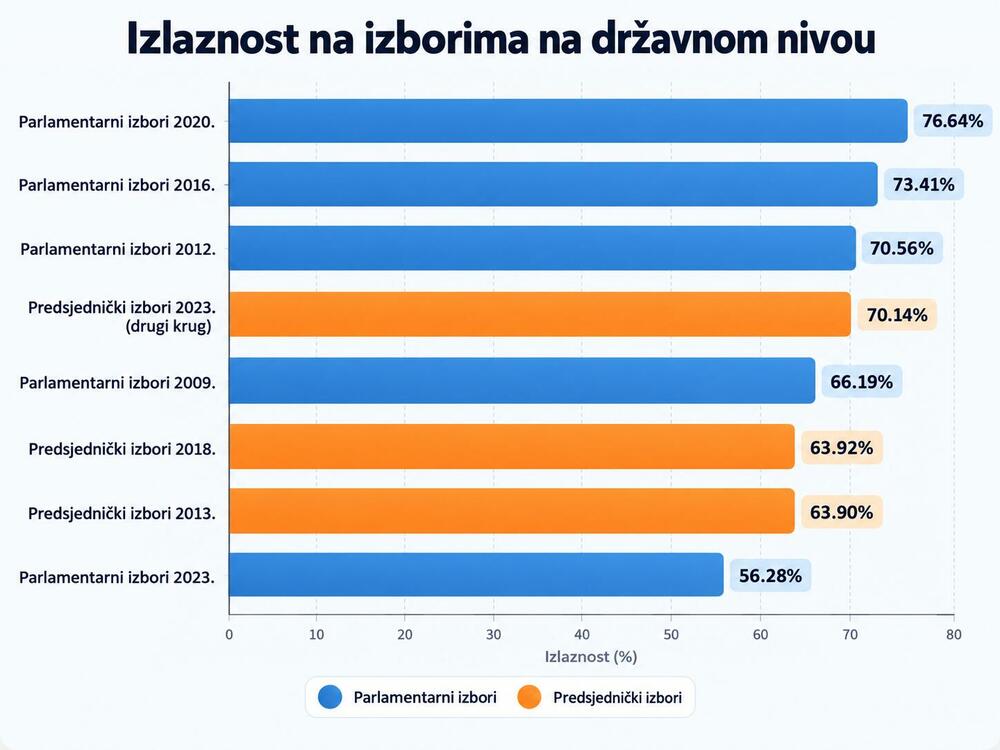
In the last parliamentary elections, the turnout was significantly lower than in all previous ones (56,28 percent). For comparison, in 2020, 76,64 percent of eligible citizens voted, in 2016 - 73,41 percent, in 2012 - 70,56 percent, and in 2009 - 66,19 percent.
Also, just a few months before the 2023 parliamentary elections, the turnout in the second round of the presidential election was 70,14 percent.
In numbers - 305.324 voters voted in the last parliamentary elections, 413.894 in the penultimate, and 388.220 in the 2016 elections. In 2012, 362.714 citizens with the right to vote exercised their right to elect deputies to the State Assembly, and in 2009, 329.819 of them.
In the second round of the last presidential election, 376.361 citizens voted, five years earlier 340.462 (63,92 percent), and in 2013 326.803 (63,9 percent).
The decline in voter turnout is also present in the capital, where in the 2024 local elections, 56,5 percent of eligible voters (82.282 in total) exercised their right to vote, compared to 69,3 percent (99.553 in total) two years earlier. The trend continued last year in the elections in Nikšić (down from 80,5 to 72 percent) and Herceg Novi (down from 66 to 51,33 percent), compared to 2021.
COMBINATION OF FACTORS
Nenezić estimates that there is no single cause for the increase in abstainers, but rather that it is a combination of political, institutional and demographic factors.
As he points out, the first is the weakening of the pronounced political polarization that has motivated citizens to vote for years.
"In Montenegro, people often voted to prevent or defend something, and less based on an assessment of specific public policies. When a change of government became possible and when it happened, one of the strongest motivations for going to the polls weakened," she believes.
The second factor is disappointment with expectations from 2020 (when the DPS government was replaced).
"A segment of citizens expected a stronger rule of law, more efficient institutions and a different way of governing. Instead, we witnessed frequent changes of government, institutional blockages, party recruitment and unstable coalitions, including at the local level. When voters get the impression that their vote does not clearly determine the direction of the government, but that the final outcome depends on post-election negotiations and party calculations, withdrawing from the electoral process is an expression of their political stance," she says.
Nenezić adds that the third factor is the so-called election fatigue.
"Montenegro has been in some kind of election campaign almost continuously since its independence. When we add to this the fact that local elections have been held at different times until recently, individual election cycles lose their significance, and citizens have fewer reasons to perceive each of them as crucial," he explains.

The interviewee of "Vijesti" points out that the fourth factor is structural, but also that it is often overlooked.
"The voter list contains a significant number of citizens who live and work abroad, and the emigration of young people continues. Some of the 'abstainers' are actually people who are not physically present in the country. That is why the real turnout among citizens living in Montenegro is higher than the official one. This effect is strongest in local and special elections, when the diaspora is not mobilized," explains Nenezić.
Đukić adds that the cause of the increase in abstainers is "changes in the parties in power without the feeling that the political climate has fundamentally changed."
"It doesn't matter whether it corresponds to the objective truth or not, the point is that this is the perception of citizens. And when you don't have a sense of change, you don't have the energy to engage in any political framework," he believes.
IT WILL NOT FALL YET, BUT NOT TO THE LEVEL OF 2020.
The newspaper's interviewee does not expect the trend of declining voter turnout to continue in the upcoming parliamentary and local elections, scheduled for next year.
"I think 2023 marked the end of an election cycle, and not necessarily the beginning of a permanent decline in political participation. The 76,6 percent turnout in 2020 was exceptionally high and the result of specific political mobilization around the Law on Freedom of Religion and the issue of the removal of a thirty-year-old government. When this strong mobilization motive weakened, some voters became demotivated. This was also contributed to by the specific circumstances of the 2023 elections, which were extraordinary, held in the middle of summer and only two months after two rounds of presidential elections," she believes.
In Montenegro, people often voted to prevent or defend something, and less on the basis of an assessment of specific public policies. When a change of government became possible and when it happened, one of the strongest motivations for going to the polls weakened, says Ana Nenezić
Nenezić points out that for 2027, the key factor will be the way the elections are organized.
"If the parliamentary and all local elections are held on the same day, as previously announced, I expect a higher turnout than in 2023. The reason is very simple. Holding the elections simultaneously will encourage the mobilization of party structures in all 25 municipalities, activate local candidates and their networks, and increase the importance of election day itself for voters," he explains.
She estimates that, under that condition, turnout could be between 60 and 65 percent, or return to the average of previous election cycles, which would be a recovery compared to the last parliamentary elections, but still significantly below the mobilization in 2020.
However, he adds, if the elections are separated, he expects that the parliamentary elections could attract slightly more voters than in 2023, while local elections in some municipalities could maintain a relatively low turnout.
"Of course, the final turnout percentage will be influenced by the intensity of the campaign, the offer of political actors, and the possible emergence of new topics or actors that can mobilize voters and thus increase or decrease voter interest," he points out.
Djukic also believes that this trend will not continue.
"Back then, we had specific situations of constant elections that didn't change much and voters were disappointed with the previously established parties on offer. Now, however, we have a longer period during which there were no elections, and citizens will once again be convinced that something concrete can be changed in our system through elections," he explains.
PES CAN GO TO ABSTINENTS, OTHERS TO TRADITIONALS
Nenezić is not optimistic that the current parties will go towards abstainers as their electorate, noting that they declaratively want to.
"In practice, mobilizing existing voters is simpler. Working with abstainers is expensive and uncertain, while mobilizing a 'safe vote' through identity messages and party networks is a proven technology. That is why I expect most actors to build their campaign on polarization, which reliably motivates voters in Montenegro, as well as warnings about the negative consequences of a victory for political opponents," she believes.
Đukić shares her view, adding that abstainers are a "necessary evil" for parties.
"They don't know how to approach them or what to offer them. They mostly appeal to their existing base in the hope of maximizing support. Only perhaps the PES is trying to make a bigger demand through economic issues," he points out.

Nenezić also sees PES as an actor that can use an economic narrative to target abstainers.
As he adds, the party's experience from the last parliamentary elections, in which they were the political entity with the most votes, shows that there is room for a different approach.
"Concrete economic promises and the presentation of a political alternative helped the party attract a segment of voters who were not firmly attached to traditional political blocs. This does not mean that every one of these voters abstained in the past, but it shows that electoral support can change when an offer appears that responds to the immediate problems of citizens. The key question for the next elections will be whether a party, existing or new, will succeed in turning dissatisfaction into trust," he explains.
Nenezić adds that criticism of the existing authorities may be enough to make a voter dissatisfied, but it is not necessarily enough to motivate them to vote.
However, she reminds that abstainers are not a homogeneous group and should not be viewed as a single electorate waiting to be won over by a party, but that among them may be disappointed voters who supported the changes in 2020, former DPS voters who have weakened their connection with that party, young people who have never firmly identified politically, as well as citizens who are traditionally uninterested in participating in elections.
"Traditional parties, including the DPS and the parties of the former Democratic Front, have the capacity to bring back some of their former voters, especially if they base their campaign on mobilization around identity issues and fear of the victory of the opposing political bloc. However, such a strategy has limitations when it comes to citizens who have distanced themselves from politics precisely because of constant polarization. Winning over voters who do not want to choose between existing blocs will require a convincing offer that does not rely dominantly on these issues," believes Nenezić, adding that there is room for existing civic and new political entities.
Đukić points out that PES still does not have a solid party electorate, and that therefore it may to some extent also go towards abstainers, while other political entities "are mostly not interested or trying to expand their support."
They (the parties) do not know how to approach them or what to offer them. They mostly address their existing base in the hope of maximizing support. Only perhaps PES is trying to make a bigger demand through economic issues, believes Stefan Đukić
SNP: WARNING, WE MUST MOTIVATE WITH RESULTS
"Vijesti" asked most parliamentary parties whether and how they plan to motivate abstainers to vote in the next elections, but also whether they believe that the increase in their number has been contributed to by disappointment in the new government.
Responses were submitted only from the Socialist People's Party (SNP).
"The drop in voter turnout is a serious warning for all political entities in Montenegro. I would say that it is a kind of alarm that needs to be examined more thoroughly and from multiple angles. Namely, when a large number of citizens decide to stay at home, it means that there is a certain level of disappointment, distrust or a feeling that the vote has no value. The SNP does not underestimate this signal and we regularly try to look at the causes," the party said.
They added that "their task is to motivate citizens, above all, with concrete work and clear results, responsibility and a policy that is not based on divisions, but on overcoming life's problems."
"People do not vote for big slogans and catchy slogans, but when they believe that their vote can really bring better standards, safer jobs, fairer institutions, a stronger local community and a more peaceful future for their families. So, tangible and concrete things that mean life, not abstract slogans that raise tensions and draw targets. The SNP will, as before, continue to talk directly with citizens, visit municipalities, local communities and households, listen carefully to needs and problems and offer realistic, achievable solutions. We believe that trust is not returned overnight, but through daily hard work and dedication, an honest and clean attitude towards citizens and a clear policy that always puts the common man and his needs at the forefront," they point out.
From the party he leads Vladimir Jokovic They believe that "it is true that some voters who wanted changes after 2020 are today disappointed with the pace of their implementation, political conflicts, divisions, but also the lack of expected results in certain areas."
"Whoever ignores such a situation or tries to shift the responsibility to someone else is in big trouble. Everyone who participates in government must bear some of the responsibility because that is the only way to show seriousness in engaging in politics. More results and less political back-and-forth are necessary. That is the formula for success. The SNP sees its responsibility in being a factor of stability, agreement and concrete solutions, deeply believing that politics in its essence must return to the citizens, and not become a hostage to all sorts of party squabbles. For this very reason, we will continue to strongly insist on social justice, balanced development of Montenegro, protection of pensioners, workers, tenants, families, youth, the academic community, as well as on permanent and comprehensive strengthening of institutions," they say.
They also point out that "abstainers should not be pressured, but rather convinced that politics can be responsible and useful, and their voice valuable and decisive in many matters."
"The SNP will strive to show through its work that the citizens' vote has meaning and that the changes people voted for must be visible in everyday life," they told "Vijesti".
Low turnout corresponds to DPS, high to PES
Nenezić believes that low turnout is, in principle, appropriate for parties that have a strong base - that is, a disciplined, loyal and organizationally well-connected electorate.
"They can achieve a relatively good result even when the total number of voters who turn out for the elections is smaller. This may be an advantage for DPS, whose support in the previous period was relatively stable, as well as for certain minority parties, which have a more cohesive electorate. The results of the local elections in Podgorica 2024 and Nikšić 2025 can also be viewed in this context," he points out.
On the other hand, he adds, higher turnout may suit political actors who depend on voters with weaker party affiliation, or those who make their choices depending on the specific offer and political moment.
"This category includes PES, which in 2023 attracted a significant number of voters outside of traditional political bases, but also new political actors who manage to mobilize dissatisfied citizens, and those who were previously less interested in elections," he explains.
Đukić has a similar view. He believes that low turnout suits the parties with the “most disciplined electorate” - DPS, NSD and to some extent the Democrats.
"The others hope that the undecided or undercommitted will choose them," he adds.
DPS lost voters from 2020 to 2023, but the picture is changing
Nenezić points out that, based on the election results, it is difficult to give a precise answer to the question of who is more among the abstainers - disappointed voters of the current or previous government.
"If we compare the absolute numbers of votes from 2020 and 2023, we see that DPS suffered a major loss of support during that period, while part of the former opposition bloc managed to retain a significant portion of the electorate through several different political entities. However, from this data we cannot say how many former voters stopped voting and how many changed their political choice," he explains.
As he adds, in the period after 2023, the picture has changed.
"DPS has maintained relatively stable support, while some government actors, especially the Democrats and part of the PES electorate, are facing challenges in maintaining support from previous elections. This shows the possibility that some of the government's disappointed voters are withdrawing from the electoral process or seeking an alternative among other parties," Nenezić believes.
According to her assessment, among today's abstainers there could be a significant number of citizens who voted for change (the current ruling parties) in 2020 and 2023, and now see "the continuity of old patterns" - which demotivates them from participating in electoral processes because they lose confidence that their vote can change anything.
Đukić believes that abstainers are, to a large extent, those who voted for changes in the August 30th elections, but did not feel any concrete improvement afterwards.
See more:
Download the app and follow the news


FOLLOW US ON

