



Montenegro is closest to the end of its European integration with a clear path to sign an accession treaty with the European Union (EU) next year, said today in Brussels the EU High Representative for Foreign Affairs and Security Policy and Vice-President of the European Commission Kaja Kalas.
She said that the European Commission (EC) adopted today the 2026 Enlargement Package for candidate countries, and what is new is that it contains roadmaps for the most advanced members, including Montenegro.
She said that enlargement is one of the EU's most important policies, which strengthens peace, stability and prosperity across the continent.
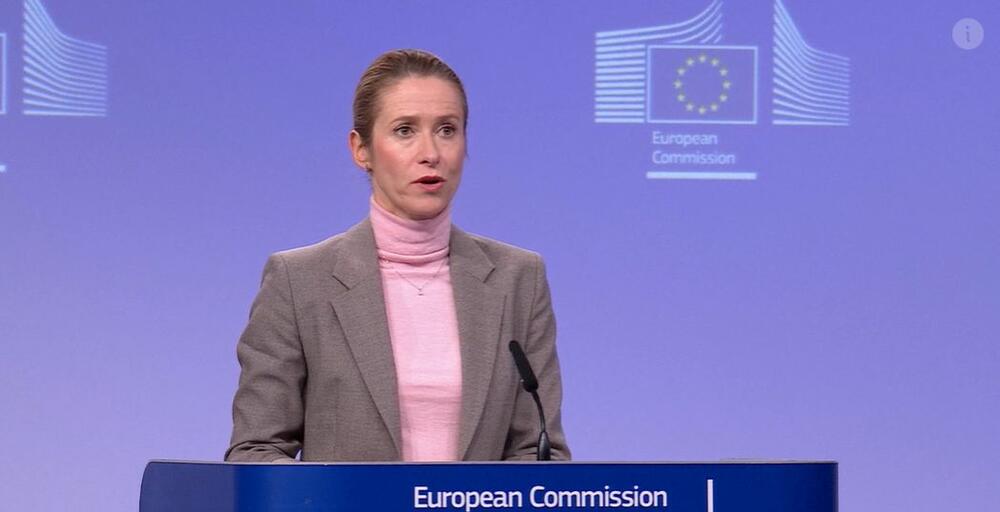
European Commissioner for Enlargement Marta Kos said that for the first time since 2011, the EC has the opportunity to conclude negotiations with a candidate country, namely Montenegro, this year.
"Montenegro is on track to become the 28th member of the EU in 2028," Kos said, adding that the Accession Treaty will likely be signed in the summer of next year.
Montenegro has made decisive progress in fundamental areas
Presenting the report, Marta Kos said that Montenegro has also made decisive progress in fundamental areas, with good results in the rule of law, economic governance, statistics and public administration reform.
"The country has already closed 21 negotiation chapters, and according to the European Commission's assessment, Montenegro has met all the conditions for closing the remaining chapters. Accession negotiations could realistically be completed by the end of this year," she stated.
Albania to maintain the pace of reforms
Albania, she said, is one of the countries leading the accession process and has managed to maintain the pace and in just over a year has opened all negotiation clusters. It has met the interim benchmarks in the core areas and provisionally closed the first four chapters.
“This is a significant achievement. Albania must maintain the pace of reforms in order to move forward towards closing the remaining chapters. The rule of law, an independent judiciary, media freedom and the protection of fundamental rights must be at the heart of all reform efforts. This is important not only for EU membership but also for Albanian society and the daily lives of citizens.”
She said that the essential involvement of the entire society is necessary to ensure a quality legislative process and reforms that bring results in practice.
Moldova best student
Kos said that she used to say that Moldova was the best student in her class, and now she has to say that it is achieving the best results in the class - progressing in leaps and bounds, despite unprecedented external pressures.
“It has shown strong determination to accelerate reforms, including difficult reforms, such as the integrity check of judges. The European Commission assessed that Moldova has fulfilled the conditions for opening all remaining negotiation clusters. The country has also made significant progress towards meeting interim benchmarks in key areas before the end of this year. Greater emphasis will be needed on the implementation of laws and their effective enforcement.”
This, she added, includes achieving convincing results in investigations, prosecutions, and issuing final court decisions in corruption cases.
The next priority will be to stimulate the growth of the Moldovan economy, create new jobs and strengthen energy security.
Ukraine is making progress in the most difficult possible circumstances
Kos recalls that Ukraine continued to progress towards membership in the European Union in the most difficult possible circumstances.
"More than four years after the start of Russian aggression, Ukraine has continued to implement reforms during the reporting period, and the pace of their implementation has recently accelerated further. There is no other country in the world that is progressing towards EU membership under such difficult circumstances," she pointed out.
As she added, Ukraine's progress demonstrates the determination of its people to build their future within the European Union.
“We expect to open all remaining negotiation clusters by the end of the year. The joint working group we launched in October is ready to advance key reforms in the areas of the rule of law and the fight against corruption. It will help Ukraine progress towards the interim benchmark assessment report in the first half of 2027.”
According to Kos, further progress in the area of the rule of law will be essential to maintaining the reform momentum.
This will require unity in Ukraine between the Government, Parliament, and civil society.
The brake on North Macedonia's path still exists
North Macedonia has improved its level of preparedness, although, as Kos said, the brakes on its accession negotiations are still lifted.
"North Macedonia has recently accelerated reforms under the Growth Plan and is working intensively to improve its readiness for EU membership. We now need to see greater progress in the fight against corruption and the implementation of public administration reform."
When it comes to compliance with EU legislation, North Macedonia is among the countries with the highest level of preparedness.
Kos stated that in order to move to the next phase of accession negotiations and open Cluster 1, which covers fundamental areas, the country must adopt constitutional amendments agreed with the EU in 2022, which relate to the inclusion of minorities.
Bosnia and Herzegovina is moving away from the European path
"In Bosnia and Herzegovina, we are noticing a growing departure from the European path. BiH urgently needs to appoint a chief negotiator and adopt important judicial reforms. Without these steps, the European Commission cannot propose a negotiating framework to the EU Council," Kos warned.
She added that after the elections, Bosnia and Herzegovina has an opportunity to demonstrate renewed commitment to reforms and make progress towards opening accession negotiations.
Kosovo needs political stability.
Kos pointed out that Kosovo needs political stability to enable progress on its European path.
She recalled that the Government worked under a technical mandate for most of the reporting period.
"It is good to see that the EU accession process is a political priority of the new Government. However, the changes related to the Kosovo Specialized Councils pose a risk of stalling the process. The commitments made must be respected," she said.
Serbia is regressing in fundamental areas
According to Kos, Serbia has recorded a setback in fundamental areas, and the new government will have the opportunity to reverse that trend.
“Serbia is among the candidate countries with the highest level of alignment with EU legislation and is well prepared for the single market and competitiveness. However, accession negotiations have stalled over the past year. Yes, Serbia has taken further steps backwards in the area of fundamental rights, especially when it comes to freedom of expression, public administration and academic freedoms. Now it has the opportunity for a new start.”
According to Kos, the new Serbian Government has the opportunity to turn a new page, strengthen democratic institutions and fundamental rights, and take the necessary steps for Serbia's progress on its path to joining the European Union.
The rule of law is collapsing in Georgia
Kos warned that the rule of law is collapsing in Georgia and fundamental rights are being restricted.
"Georgia's accession process to the European Union has been de facto halted. The situation has been further worsened by serious democratic setbacks, the rapid erosion of the rule of law and the curtailment of fundamental rights. The European path remains open if the Georgian authorities change course and recommit to democracy, the rule of law and fundamental rights," she said.
Turkey remains a strategic partner, but recent developments have deepened the gap with the EU
Kos said that Turkey remains a candidate country and a strategic partner of the European Union.
“We share strategic interests in several key areas, including migration, trade, transport and energy. European leaders have stressed the EU’s strategic interest in developing a cooperative and mutually beneficial relationship with Turkey. However, recent developments in the areas of fundamental rights and the rule of law, including the independence of the judiciary, freedom of the media, the rights of LGBTIQ+ people and local democracy, have further widened the gap between Turkey and its goal of joining the EU.” He points out that the underlying reasons for the stalled accession negotiations remain.
The expansion pack is much more than a collection of reports
Kos said that the enlargement package they present today is much more than a collection of reports on individual countries.
"It is much more than an assessment of reforms, benchmarks and progress. It is about the future of our Europe. It is about whether we have the courage to complete the European project, to further connect our continent, to expand the space of peace, democracy and prosperity and to make Europe stronger in an increasingly uncertain world," Kos said.
This, she said, will require political courage, trust and hard work from both sides.
He reminds us that the European Union has never been just a project of institutions, markets and treaties, but has been and remains a project dedicated to people, freedom, peace and the possibility of living together.
"Our task is not just to manage enlargement. Our historic opportunity is to achieve European unification, and the 2026 enlargement report represents another important step in that direction," Kos concluded.
"Reforms bring results"
Kaja Kalas pointed out that today's report sends a clear message: reforms are bringing results.
"Albania has opened all negotiation clusters in just over a year. The task now is to maintain the momentum by accelerating reforms. Moldova continues to make progress. Despite unprecedented external pressures, it has remained consistent in its commitment to reforms and alignment with European Union legislation," she said.
Ukraine, she added, is implementing comprehensive reforms under Russian bombs.
According to her, no candidate country has ever implemented reforms of this scale while at war, and this deserves recognition.
"Based on the progress that Ukraine has made, we should proceed with the opening of all negotiation clusters before the end of the year," said Kalas.
When it comes to Bosnia and Herzegovina, Kosovo, North Macedonia and Serbia, the prospects for progress are, as she stated, uneven.
"Turkey remains a candidate country and a key partner, but the conditions that led to a standstill in its accession process still exist. Georgia has embarked on a path of confrontation with the European Union due to its backsliding in democracy and fundamental rights. Its EU accession process remains de facto stalled," said Kalas.
She emphasizes that the obligations undertaken on the path to membership do not cease to be valid upon accession to the EU.
"This year's report puts the security dimension of enlargement in much clearer focus. For the first time, it contains a separate chapter dedicated to security and defence. Over the past year, most candidate countries have increased or maintained a high level of alignment with the EU's common foreign and security policy. This is an important indicator of their strategic commitment and commitment to European values," she said.
As she added, many candidate countries are already contributing to Europe's security - Ukraine represents Europe's first line of defense against Russia.
"Kiev's battlefield experience is unparalleled and crucial for European security and defense readiness. Moldova and our partners from the Western Balkans contribute to EU missions and operations. They help protect our borders and counter foreign manipulation of information. These contributions also strengthen our security," she said.
According to her, a larger European Union will be able to rely on them in the future.
As she said, enlargement has been the European Union's most successful foreign policy for decades.
"Each round of enlargement has changed our continent. Today's geopolitical reality makes the next round of enlargement even more urgent. Where countries that are making progress are left waiting, space for instability is created. Enlargement is a direct investment in Europe's security," she said.
DON'T MISS IT



See more:
Download the app and follow the news


FOLLOW US ON

