



The end of one of the best and most beautiful chapters for Bosnian and Herzegovina's football. After 19 years of playing for the national team, Edin Džeko has ended his career. Zenica breathed as one last night, it was the center of BiH, and the Bilino Polje stadium was too small for all those who wanted to come and see Džeko off to his well-deserved national team retirement.
He played 152 games for the "dragons", scored 73 goals, the absolute record holder in both categories. But, the Zenica arena was not sold out in - symbolically - 11 minutes because of that, it would have been sold out even if he had played many fewer matches and scored a few goals less. Džeko, with his behavior, attitude and character, has built himself into an idol of the entire nation during his career. Two trips to the World Cup - is that not enough?
DON'T MISS IT
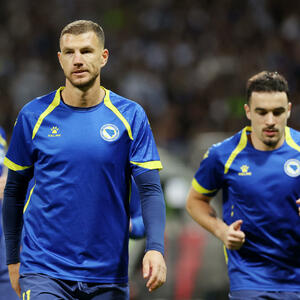
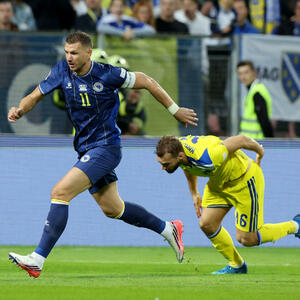
The status of an idol, someone who generations and generations of Bosnian football players look up to, was built, in addition to great playing qualities, also because of his human qualities. That is why people in Bosnia and Herzegovina do not look at him as a football player. They see Edin as a true ambassador of their country, someone who represents them to the world in the right way.
The day before yesterday's match, a large Džek jersey with his number 11 was unfurled above one of the symbols of Sarajevo, the Eternal Flame. Everything was in the name of that number. The famous specialty "10 in half with onion" was yesterday, in Džek's honor, "11 in half with onion". On public transport vehicles in the capital of Bosnia and Herzegovina, the number 11 was displayed with a thank you to the captain for everything he did for the country - both on and off the field.

Džek's character is something different – a perfect blend of Sarajevo's hustler, but also that real gentlemanly charm with which he "ravaged" the strongest world leagues. All of this was shaped during the war years in Sarajevo during which Edin grew up.
"I was a child when the war started and I wasn't aware of many things, but war makes you grow up faster, learn things you would never learn and live differently," the current Schalke striker once said.
Belma's mother is an important figure in his life, and without her intuition, the question is what would have happened to her son.
"She saved my life when she once wouldn't let me play football with my friends in the meadow. A few minutes later, a grenade fell on that meadow and many of my friends were killed," Dzeko said in an interview with Bild after signing for Wolfsburg.
However, even those terrible war years did not quench Edin's desire for football. Shortly after the end of the war in Bosnia and Herzegovina, at the age of 10, he began training football at Željezničar. From there, he went to the Czech Republic, then to Wolfsburg, and in the meantime, he received his first call-up to the national team. He was called up by the then Bosnia and Herzegovina coach Fuad Muzurović in May 2007. He was given the opportunity to make his debut and immediately shone – in a victory over Turkey (3:2) at the “Asim Ferhatović Hase” stadium in Sarajevo, Džeko scored the first of his 73 goals in a jersey with the national emblem.
HOW IT BECAME A “DIAMOND”
Over the years, Džeko, thanks to his excellent performances both in clubs and with the national team, became known by the nickname "diamond".
Sports journalist Marjan Mijajlović shouted “Diamond!” during the broadcast of the Belgium-BiH (2:4) match in the 2010 World Cup qualifiers, after Džeko’s masterful goal for 0:1 in the seventh minute. Today, 17 years after that match, it is a generally accepted nickname for Džeko.
THE MAIN AND RESPONSIBLE FOR THE 2014 WORLD CUP.
The dreams of all generations of football workers and fans in Bosnia and Herzegovina came true in October 2013. With a victory over Lithuania, the “Dragons” officially secured a historic place in the World Cup in Brazil, which was held in 2014. It is not realistic to single out one player from that team as Safet Sušić, considering that there was a lot of class in it, but if necessary, then it is Džeko.
In the qualifiers for that competition, BiH scored 30 goals, and as many as 10 were the work of Edin.
"That tournament was historic for us. It showed that Bosnia and Herzegovina can be on the biggest stage. It united the people and even today, when Brazil 2014 is mentioned, people smile," Džeko once said.
At the World Cup, the “dragons” were denied a chance to reach the knockout stages by the referees after a completely legal goal against Nigeria, scored by Džeko. However, Edin managed to score against Iran, which remained his first and only goal at the World Cup for the national team.
HE WAS THERE WHEN IT WAS HARDEST
It is human nature not to think of giving up when everything is going smoothly and easily. However, when things get complicated, many people think of “raising anchor.” For years after that World Cup in Brazil, the Bosnia and Herzegovina national football team fell lower and lower.
Coaches and players changed as if on a tape, the audience's interest waned, there were some unpleasant scenes, but Džeko was always there. And that's the answer to the question of why people in Bosnia and Herzegovina love him so much – besides the fact that he was always there to score an important goal, two or three.
LEADING A NEW GENERATION
When Sergej Barbarez came to the "Dragons" bench in April 2024, it was felt that a new, positive wave for Bosnian football was coming. That is exactly what happened. Many talented young footballers born outside, but originally from Bosnia and Herzegovina, accepted the invitation to wear the "Dragons" jersey, and the role of mentor, leader and extended hand of the coach was taken on by none other than Edin Džeko.
He slowly tempered the young guys, suffered with them through the heaviest defeat in the history of the national team against Germany (7:0), and then in March of this year, it came back to them.
They finished second in qualifying group H and reached the World Cup play-offs. Their first rival was Wales, away. A brilliant goal by Daniel James put the Welsh ahead, and it seemed that the “Dragons”’ dream of a second World Cup appearance was quickly fading, but Džeko did not want to say goodbye to the national team just like that – a sky-high jump in the 86th minute and a goal that, as it turned out, took the match first into extra time and then into penalties.
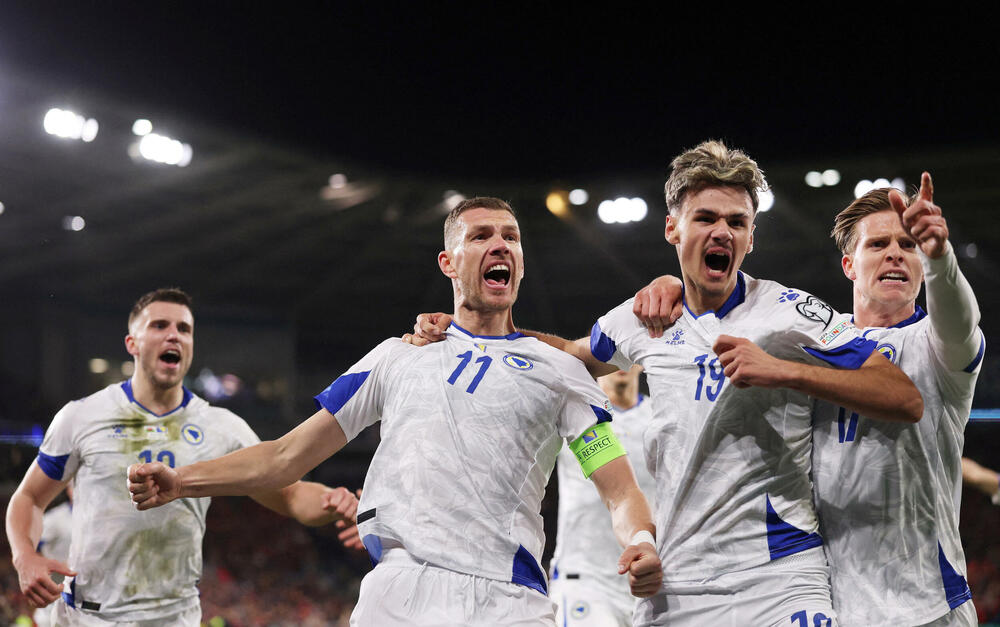
Bosnia and Herzegovina made it through that playoff final against Italy. As captain, he led the "dragons" to one of the greatest victories in the history of Bosnian football and a night that will be talked about for generations to come.
Edin crowned his international career with another historic result – reaching the knockout stage of the World Cup.
And so last night, in front of his audience, in front of his people, he brought down the curtain. He handed the baton to the younger players, and at the press conference before the match, he stood in front of the entire generation as a captain and told the fans and journalists to "look after his children."
When asked if there was a possibility of him ever returning to the national team, he had a response that was typical of him: "That's right."
Now it's time for some other players to take over his role. True champions feel it, recognize it... And Edin Džeko certainly is.
See more:
Download the app and follow the news


FOLLOW US ON

