



The Republic Election Commission (RIK) of Serbia voted after midnight on a proposal for polling stations abroad that had previously been submitted by the country's Ministry of Foreign Affairs (MFA), which was sharply criticized by some members of the commission, stating that the voting rights of a large number of citizens from the diaspora would be jeopardized, and that they had not received an adequate explanation from the relevant ministry on how the list was compiled.
One of the commission members, as reported by Beta, stated that Herceg Novi, where the Serbian consulate is located, "is not open now."
At yesterday's session, several of them proposed that the ministry be asked to increase the number of polling stations that will be opened abroad, or claimed that there were no legal obstacles if the list of cities where Serbian citizens will be able to vote were to increase in a few days.
Critics of the decision stated that they were forced to vote for this solution, because voting against would mean that the proposed locations would not be approved either, stating that the number of citizens who registered to vote abroad was many times higher than in previous years, and that they represented a significant electorate that could determine the election.
DON'T MISS IT
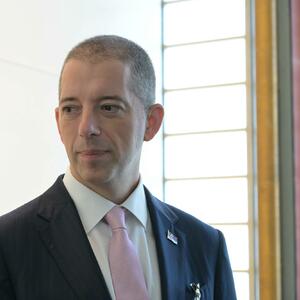

The President of the Serbian Election Commission, Vladimir Dimitrijević, said that there were 81 polling stations abroad in the last elections, and that 93 polling stations were proposed by the Ministry of Foreign Affairs (MFA).
He added that a larger number of registered voters does not necessarily imply that the number of polling stations abroad should be proportionally increased, that several working group meetings were held on this issue with representatives of the Ministry of State Administration and Local Self-Government (MSA) and the Ministry of State Administration and Local Self-Government (MDULS), and that the latest amendment to the proposal was made because "a lot more registrations" for voting abroad had arrived since October 2.
He also stated that members of the Revision Commission should not disclose data on the number of registered voters, but at one point he announced that there were more than 100.000, and he also praised the amount of work done by diplomatic and consular missions and the Ministry of Foreign Affairs.
"(They) had a huge job ahead of them, due to the number of applications. I can say that there was no slowdown in applications... I myself analyzed it, we see that some polling stations are attached to others - there are fewer in some countries, as the MSP stated, for security reasons," Dimitrijević added.
On the other hand, RIK member Ivan Šebek said that representatives of the MDULS were present only twice, and that - although they are legally obliged to do so - they did not provide RIK members with the information they needed for their work.
He added that he has been a permanent member of the RIK for 15 years and that he has "never experienced" such behavior from the two ministries.
"I asked them to provide us with information on how many citizens abroad registered individually by city and country. We did not receive that. I also asked them to provide letters in which they addressed the host countries... They did not provide us with that information either. We still do not know how many Serbian citizens, by city and country, registered to vote. What we do know is that, in relation to the 2023 elections, we now do not have (polling stations in) Geneva and Lugano in Switzerland, in Canada we do not have Vancouver, Bucharest, Bratislava, Sofia, Lebanon, UAE...", stated Šebek.
He said that if the MDULS had provided them with the information they requested, the RIK would have known whether enough people had registered in those cities.
"We would also know the criteria by which people in Germany were distributed to other cities and by what criteria. We asked the MFA for a letter in which they addressed Germany to ensure that they could vote outside diplomatic and consular missions, because we know that such a letter was never sent to Germany - and that they were expecting that letter yesterday - which did not arrive. Because they would have urgently approved voting in places that are not diplomatic and consular missions," said Šebek.
He concluded that representatives of neither the MSP nor the MCLS appeared at yesterday's working group, assessing that representatives of the Serbian Ministry of Foreign Affairs went beyond their jurisdiction when they proposed the time of voting, i.e. the opening and closing of polling stations in certain countries.
Member of the Serbian Election Commission, David Krstić, listed cities where, according to the Student List records, enough people had registered, some of whom had secured a polling place.
He assessed that this proposal may discriminate against citizens and violate the Constitution of Serbia.
"In Australia, Melbourne has been designated (as a polling station), Perth and Brisbane have not, although they are 2.700 and 1.350 kilometers away from that place. Graz and Innsbruck are not included in any polling station, although according to our information, 300 people registered there. There is no longer a polling station in Sofia, although there was one in the last elections. Vancouver had a polling station, but now it is not marked anywhere, according to our information, almost 1.300 citizens registered there, and now they are 3.500 kilometers away. The situation is similar in France - Nice, Lyon and Toulouse are included in Paris, despite being hundreds of kilometers away," Krstić pointed out.
As an example, he cited Thessaloniki, which no longer has a polling station, although there is a Serbian consulate there.
"Rome, Milan and Trieste have been designated as polling stations in Italy, and other places in Italy are not included in these polling stations. Herceg Novi, which has a consulate, is now not open. We no longer have an open polling station in Romania, although we have an embassy in Bucharest and a consulate in Timisoara. According to our information, almost 400 voters have registered in Bratislava," he added.
He also stated that in BiH there has been a 44 percent increase in the number of registered voters, that 11 additional polling stations have been opened there, and that in Germany, for example, there has been a 145 percent increase in registered voters - with only two additional stations open.
He also requested that the Serbian MFA answer the question of why they did not receive information on the number of registered voters from the MFA so that the REC, which is responsible for deciding on this issue, could make a decision.
"They were asked to submit data and an explanation - not this blanket one - why polling stations were not opened in all of the above. We cannot see anything from this. The RIK still has the option to request the MSP to supplement this proposal, and on that basis the decision will be amended or supplemented," concluded Krstić.
Member of the Serbian Election Commission Marija Jovanović said that her general impression was that colleagues from the Ministry of Foreign Affairs left the working group meetings with a "bitter taste in their mouths", that people from the Election Commission "treated them as if they were in the dock", even though they had done a great job.
She stated that two more polling stations have been opened in Germany, two in Australia, one in Indonesia... in other words, that a major step forward has been made in opening new polling stations.
"I am sorry that some of our citizens have to travel a little longer to exercise their right to vote, but if someone wants to do something - Picasso said that a long time ago - they find a way, and if someone doesn't - they find an excuse," said Jovanović.
Vladimir Dragaš assessed that the letter from the Serbian MFA acts as an "excuse", that it is full of "very general excuses" as to why some polling stations cannot open, without specifying the difficulties that diplomatic and consular missions are encountering in opening polling stations.
He stated that the public also heard from the President of the Election Commission, Dimitrijević, last night that there were many times more registered voters, and that this was not accompanied by a multiple increase in the number of polling stations abroad.
"Nine more places, but 11 more in Bosnia and Herzegovina, which indicates that outside of Bosnia the number of polling stations abroad has actually decreased. The only explanation from the MSP for the entire planet why a place cannot be opened was for Lebanon - that it is an international peacekeeping mission, that the polling station must be outside (the barracks)... It is unclear why the ministry did not accept the proposals from our diaspora. At five sessions of the working group, we did not once receive information on how many people had registered to vote abroad.
Marko Živanović, a member of the Serbian Electoral Commission, said that since his appointment to that body, he believes that their main collective goal is to restore trust in the electoral process, and that this will not happen if they adopt this proposal from the MSP.
"It is impossible for me that we cannot meet the needs of our citizens abroad. It is unclear to me how we will justify ourselves to the voters (if we adopt it). Based on the figures mentioned in public (over 100.000 voters abroad), the high turnout, that is 2,6 percent of the electorate, which can significantly affect the election results. What are we going to do if the result is determined by two or three percent," he added.
RIK member Dušan Dinčić said that the Serbian Ministry of Justice had a job to submit a proposal, and that it did so poorly "technically, organizationally and from a civic perspective."
He adds that the adoption of this proposal means that a large number of voters will not even know where they should vote, and that the arguments about security or the cost of holding elections, which were cited by MSP representatives, are not without a valid explanation.
"The commission behaved like a drunken millionaire, hundreds of millions of dinars have been spent so far on buying fronts, numerous emergency public procurements, and then we say we don't have the money to open polling stations in the place where we have a consulate," he concluded.
28 out of 29 members of the Serbian Electoral Commission (RIK) voted for this decision.
See more:
Download the app and follow the news


FOLLOW US ON

