



Ukrainian authorities said its long-range strikes had knocked out more than half of Russia's oil refining capacity, hampering Moscow's ability to supply its forces during the four-and-a-half-year invasion.
The Defense Ministry said on Sunday that recent attacks on refineries in cities including Moscow, Yaroslavl, Ust-Luga, Perm, Saratov and Syzran had disabled 51 percent of Russia's oil refining capacity. The claim has not been independently confirmed.
Moscow and Kiev have intensified air strikes after advances along the 1.200-kilometer front line largely stalled.
Ukraine has carried out a series of attacks on refineries, from Moscow to Siberia, which earlier this year caused a major fuel crisis in Russia and forced authorities to restrict gasoline sales.
Russian officials have not provided figures on damage to the country's oil infrastructure. However, in a rare acknowledgement of the economic impact of the attacks, President Vladimir Putin said on October 1 that they had cost Russia about one percent of its gross domestic product.
"They started attacking oil refineries and openly declared their goal to harm our economy. Have they achieved their goal? Partially," Putin said at a meeting of the Valdai Forum, which brings together international foreign policy experts.
Ukrainian Defense Minister Yevgeny Khmara said that analysts from Ukrainian intelligence services, the General Staff and the Defense Ministry had assessed the effects of those attacks.
"Fifty-one percent of the processing capacity hit represents a significant blow to the enemy's economy, as well as to its ability to carry out aggression and supply its troops. Our attacks deep in the rear continue to carry the war to Russian territory," Khmara said.
Russia has historically been the world's third largest producer of oil derivatives, right behind the USA and China.
According to the International Energy Agency (IEA), some of Russia's 32 refineries have been hit as many as 15 times since the start of the war, and one refinery has been targeted every three days in recent months, creating a cycle of damage and emergency repairs that could jeopardize the plant's operations in the long term.
Ukrainian attacks are also increasingly targeting more complex fuel decontamination equipment, which takes months to repair.
The IEA says diesel production has fallen by about 30 percent, and drivers have had to wait up to 40 hours to fill up at gas stations.
Russian oil refining companies have tried to make up for losses by postponing routine maintenance and restarting facilities that had previously been put on hold.
One of the measures was to lower fuel quality standards to maintain gasoline supplies, which carries the risk of damage to engines and emission control systems.
The Kremlin also banned diesel exports, sending global prices soaring and prompting US President Donald Trump to call on Ukraine on September 13 to stop attacking refineries.
Russian bombs hit a residential area of Kharkiv, in northeastern Ukraine, on Sunday, killing six people, injuring nearly 60 and severely damaging apartment buildings, officials said, Reuters news agency reported.
Oleh Sinyehubov, governor of the northeastern Kharkiv region, announced on Telegram that three bombs had hit different parts of the city. He said 59 people were injured, 30 of whom were hospitalized, and three were in serious condition.
Beta news agency earlier reported that Kharkiv Mayor Ihor Terekhov said that at least three people were killed and 39 injured in a Russian airstrike, including three children.
"It is possible that there are people buried under the rubble of the affected apartment building. A search and rescue operation is underway," Terekhov wrote on his Telegram channel.

An earlier Russian drone strike on the city's Industrial district also killed one person, Terekhov said late Sunday. Vehicles and an administrative building were set on fire, and residential buildings were also damaged, he added.
Another person was killed in a separate Russian attack on the area of Slavyansk in Ukraine's Donetsk region, said Vadim Lyakh, head of the city military administration of Slavyansk.
He urged residents not to wait for a mandatory evacuation order, but to leave the area.
The Ukrainian Air Force said that Russia launched 205 drones overnight Monday, of which 172 were shot down or disabled.
The Russian Defense Ministry announced today that it had hit a power substation in the Kharkiv region, as well as energy and port infrastructure and vessels used by the Ukrainian military in other parts of the country.
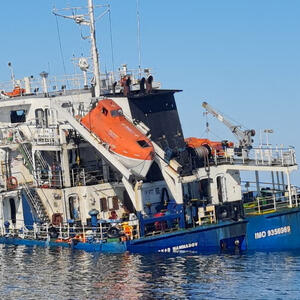
Ukrainian President Volodymyr Zelensky said a Russian drone attack caused a fire on a commercial ship that later sank in the Black Sea.
Two people died and 11 crew members were rescued, Romanian authorities said.
In a post on the X platform, Zelensky described the attack as a "terrible strike by two Russian drones on a civilian ship" in neutral waters. He said the ship was Turkish-owned and was carrying corn.
DON'T MISS IT
Ukraine has been struggling in recent weeks to defend itself against increased Russian airstrikes on cities, which include the use of ballistic missiles and high-altitude jet drones.
Kiev has been hit by frequent airstrikes, accompanied by loud explosions from drone and missile attacks. Officials and analysts say the offensive is aimed at intimidating civilians and breaking their will to resist a full-scale Russian invasion, which is expected to begin in 2022.
Adviser to the President of Ukraine Serhiy Beskrestnov announced on social media that 12 automated turrets with weapons have been installed in Kyiv to counter Shahed-type jet-powered drones, and that more such systems are planned to be installed.
He described these systems as machine guns controlled by artificial intelligence.
The Ukrainian Air Force announced that it had successfully shot down Russian jet-powered drones, including the Geran-5 model, for the first time using these robotic systems.
"Computer vision technology is used for the shootdown. Artificial intelligence allows for action even against drones with jet engines," Air Force spokesman Yuri Ignat told Ukrainian television.
The Russian Defense Ministry announced that its forces shot down 199 Ukrainian drones overnight over Russian regions, as well as over the illegally annexed Ukrainian peninsula of Crimea and the Black Sea.
Work at the border crossing between Moldova and Ukraine was suspended today after a grenade fell near a checkpoint during a Russian attack on Ukrainian infrastructure, Moldova's border police said.
It is added that the grenade fell near the Palanka-Majaki-Udobne crossing, bounced off the ground and hit a passenger bus parked at the ramp.
A bus and a house at the checkpoint were damaged, and one border guard officer suffered minor injuries, police said.
There were no other casualties. Border police advised citizens to avoid traveling to the area.
See more:
Download the app and follow the news


FOLLOW US ON

